
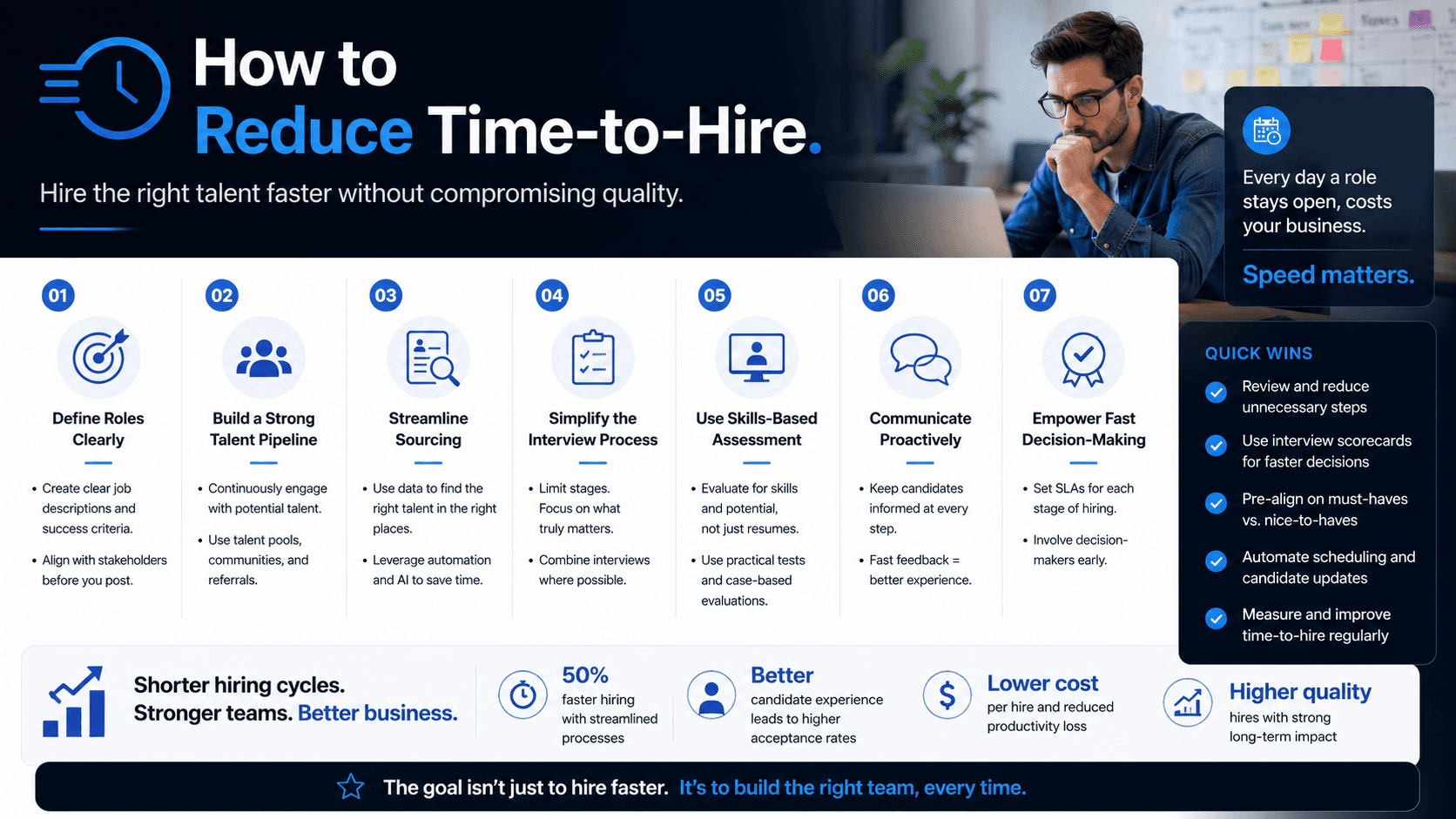
How to Reduce Time-to-Hire
The average time-to-hire sits at around 44 days. Top candidates are typically off the market within 10. That gap is the whole problem in two numbers. A hiring process that takes six weeks doesn't fail because the company picked the wrong candidate. It fails because the right candidate accepted somewhere else three weeks earlier, while the process was still working through the next scheduled interview round.
Reducing time-to-hire doesn't mean cutting corners on evaluation. It means finding where the days are actually being lost and fixing those specific points, since most of the delay isn't in any single dramatic bottleneck. It's spread across small handoffs that each seem reasonable on their own.
First, Know What You're Actually Measuring
Time-to-hire and time-to-fill get used interchangeably, and mixing them up produces misleading benchmarks. Time-to-hire measures the days between when a candidate enters your pipeline and when they accept an offer. Time-to-fill measures from when a requisition is approved to when the seat is filled, a longer window that includes time your team spent deciding to open the role in the first place.
Time-to-hire is the number your process actually controls. That's the one worth optimizing first.
Where the Days Actually Go
Unclear intake. A vague conversation about what the role actually needs sends recruiters down the wrong path for a week or two before anyone notices. This is often the single largest hidden cost in the entire process, and it happens before a single candidate is even sourced.
Manual screening. Reviewing resumes and running initial phone screens for every applicant takes recruiters roughly 23 hours per hire on average. When multiple roles are open at once, that workload backs up and pushes everything downstream.
Interview scheduling. Coordinating times across a candidate and several interviewers, especially across time zones, can add days or weeks on its own. A single busy hiring manager can stall an entire pipeline without anyone intending it to happen.
Slow interviewer feedback. After an interview happens, how long before the interviewer actually submits their assessment? In many companies, it's days, not hours, and every day of silence is a day a competing offer has to land in the candidate's inbox.
Too many interview rounds. Extra rounds add time without reliably improving decision quality. Most roles don't need more than a recruiter screen, a skills or fit interview, and a final decision round.
Offer-stage stalls. Comp approval and final sign-off can quietly take longer than the entire interview loop combined. This is often the least visible bottleneck because it happens after the exciting part of hiring is already done.
Fixes That Actually Move the Number
Fix intake first. Have a clear, agreed role definition, skills, seniority, must-haves versus nice-to-haves, before the search starts. This single step prevents the two-week detour that vague intake conversations reliably cause.
Set feedback deadlines and enforce them. Ask every interviewer to submit feedback within 24 hours, with automated reminders so a recruiter isn't manually chasing five different people. This alone regularly closes a meaningful chunk of the delay in a typical process.
Run stages in parallel where possible. Screening, hiring manager review, and interview scheduling don't all need to wait on each other sequentially. Overlapping them where the dependencies allow it compresses the calendar without skipping any step.
Cap the number of rounds. Keep additional rounds only where they add real signal. Three focused conversations usually reveal as much as five loosely structured ones.
Automate scheduling. Connecting calendars directly instead of relying on email back-and-forth removes one of the most persistent, low-value delays in the entire process.
Set a decision deadline after the final interview. Block time immediately after the last interview for the team to align and decide, rather than letting a debrief drift for a week. Long debrief delays kill offers on their own, independent of how strong the process was up to that point.
Track the number, not just the feeling. Time per stage, offer acceptance rate, and candidate drop-off rate tell you exactly where days are leaking. Teams that measure this systematically and fix one bottleneck at a time typically see meaningful reductions within a quarter, without lowering the bar on who gets hired.
What a Realistic Target Looks Like
A reasonable target for most non-executive technical roles sits in the 25 to 32 day range, well below the 44-day average, without sacrificing evaluation quality. Getting there is less about any single tool and more about fixing the handoffs between stages, since that's consistently where the actual delay hides, not in the interviews themselves.
When Fixing the Process Isn't Enough
Sometimes the honest answer isn't a faster internal process. It's that the skill you need doesn't exist in enough supply locally to hire quickly no matter how efficient the pipeline is, or the role is urgent enough that even a well-optimized 25-day process is too slow for the timeline in front of you.
In those cases, staff augmentation solves a different problem than process optimization does. It doesn't fix your internal hiring pipeline. It sidesteps it for the specific gap that needs filling now, while the pipeline improvements you're making run in parallel for your permanent hiring needs.
Where Amorisoft Fits
At Amorisoft, our IT staffing and resource deployment service exists for exactly the gap between a 44-day average hiring cycle and a deadline that can't wait that long. Professionals typically join a client's team within one to two weeks, since the vetting and sourcing work happens on our end before a candidate is ever presented, not after a client has already committed to a search.
Bottom Line
Time-to-hire rarely fails because of one dramatic bottleneck. It fails because of small, reasonable-seeming delays at intake, screening, scheduling, feedback, and offer approval that add up to weeks nobody intended to spend. Fix the handoffs, set deadlines that get enforced, and measure where the days actually go. For gaps that can't wait for even an optimized process, staff augmentation covers the distance while the fix takes hold.