
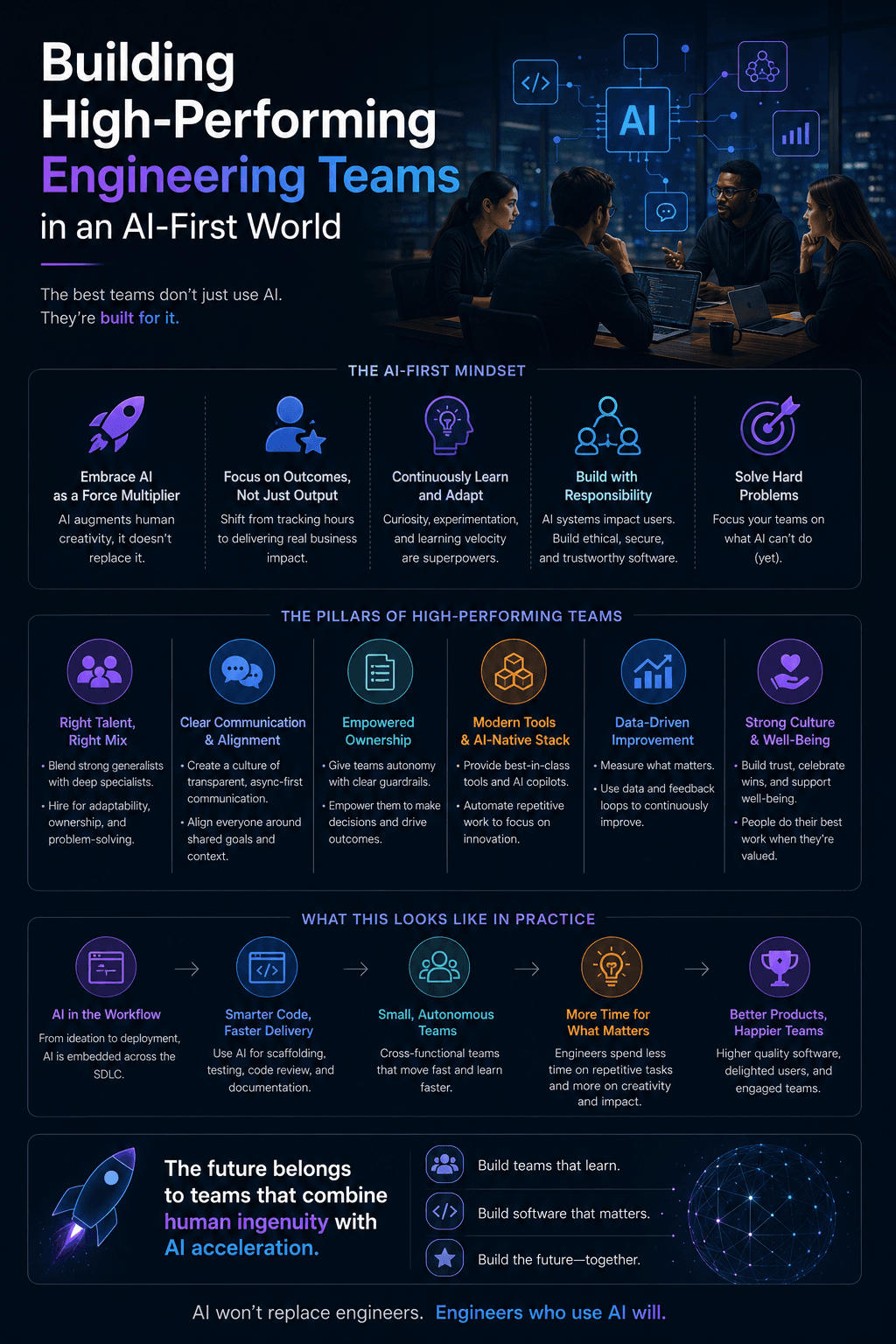
Building High-Performing Engineering Teams in an AI-First World
The assumption going into 2026 was simple. Give every engineer an AI coding assistant, watch output multiply, ship faster. The data tells a more complicated story. Faros AI studied more than 10,000 developers across 1,255 teams and found that high-AI-adoption teams completed 21% more tasks and merged 98% more pull requests. Pull request review time increased 91% at the same time. At the organizational level, the correlation between AI adoption and actual performance largely disappeared. The system moved only as fast as its slowest link, and for most teams, that link had quietly become the human approving the work, not the human writing it.
This is the part most companies miss. AI doesn't fix a broken team. It amplifies whatever was already there, accelerating the teams with strong fundamentals and making the gaps in a struggling team worse, faster.
The Bottleneck Moved
For years, writing code was the bottleneck. That's no longer true. Frontier models now generate code fast enough that the constraint has shifted downstream, to review, verification, and judgment about what should ship at all. Index.dev's 2026 research found that projects with heavy AI code generation but weak review processes saw a 41% increase in bugs. Skipping review gates entirely produced 50% higher defect rates.
The practical result: teams that kept their old review process while adding AI-generated volume on top of it got slower, not faster, because the same number of humans were now reviewing far more code. The teams that adjusted, tiering review rigor by risk, automating the low-stakes checks, kept the speed gain instead of trading it for a backlog of unreviewed pull requests.
Seniority Matters More Than It Used To, Not Less
Opsera's 2026 AI Coding Impact Benchmark, covering more than 250,000 developers, found senior engineers realized nearly five times the productivity gains of junior engineers from the same AI tools. The reason isn't mysterious. An engineer with deep fundamentals, system design, security patterns, performance tradeoffs, can direct AI output and catch what's wrong with it. An engineer without that judgment can generate code quickly and ship problems just as quickly.
McKinsey's research reached a similar conclusion from a different angle: top-performing teams combined AI with senior engineers and saw software quality improve 31% to 45%, not by replacing expertise with junior staff working faster, but by pairing AI leverage with people who already knew what good looked like.
This creates a real structural tension. Many organizations have responded by freezing junior hiring to focus on senior headcount that can manage AI output well. That solves the immediate productivity question and creates a longer one: without junior engineers today, there's a smaller pool of engineers with five years of judgment a few years from now. Teams thinking beyond the next two quarters are watching this trade-off carefully rather than defaulting to senior-only hiring.
Trust Is Its Own Bottleneck
A separate finding worth taking seriously: 46% of developers say they don't fully trust AI-generated code, and many re-verify work that's already been reviewed. That re-verification quietly kills a chunk of the speed gain AI was supposed to provide. The fix isn't a policy telling engineers to trust the tooling. It's visible metrics, tracked and shared, showing AI-assisted code performs comparably to human-written code in production. Trust follows evidence, not instruction.
What High-Performing Teams Are Actually Measuring
Story points are breaking down as a metric, because AI changes the effort calculus in ways that make point estimates unreliable. The teams pulling ahead have shifted measurement toward cycle time, the gap between starting a task and shipping it, and toward metrics purpose-built for AI-assisted work: how quickly a human can safely review and merge an AI-generated pull request, how often AI-written code causes a rollback, and how many prompt iterations it takes to get a usable result, since a high number there usually means the original spec was unclear, not that the model is weak.
Thoughtworks reports clients adopting AI-first engineering practices have cut cycle times by up to 50%. One engineering leader documented a 37% reduction in delivery time from a single change: dropping the ceremony that had built up around Agile and returning to a simpler, more direct way of working, without abandoning planning or collaboration entirely.
Team Structure Is Shrinking, Not Growing
A recurring pattern across companies operating at this frontier, Cursor, Linear, Vercel, is small teams with high leverage per person rather than large teams with AI bolted on. Structured context for AI tools, clear architectural guardrails, and tiered review rigor based on how much a given piece of code actually matters let three-person units cover ground that used to take considerably more headcount. This isn't about doing more with less as a cost-cutting slogan. It's a genuine structural shift in how much a well-supported small team can now own end to end.
What This Means Beyond the Tooling
None of this works without the fundamentals a good engineering team needed before AI ever entered the picture: clear ownership, documented decisions, and alignment between what's being built and why it matters to the business. AI adoption research keeps landing on the same conclusion from different directions: the biggest failures aren't model failures. They're review-capacity failures, unclear specifications, and organizations treating AI adoption as a tool rollout instead of the structural change it actually is.
That also means the answer to "how do we build a high-performing team in an AI-first world" isn't purely technical. It's the same discipline good engineering teams have always needed, applied to a workflow that now moves considerably faster and needs stronger guardrails to match.
Where Amorisoft Fits
At Amorisoft, our IT staffing and resource deployment service focuses on placing engineers who can operate well in exactly this environment, professionals with the fundamentals to direct AI tooling effectively, not just use it. For clients building or scaling engineering capacity, that distinction has become one of the most consequential parts of who gets placed on a team, since the productivity gap between a senior engineer and a junior one using the same AI tools is now measured in multiples, not percentages.
Our Clients scaling engineering capacity in this environment have found that the model of hiring matters less than who's actually being hired, and how well that person's judgment holds up when the volume of code moving through review triples.
Bottom Line
AI hasn't lowered the bar for what makes an engineering team high-performing. It's raised it, and shifted where the bar actually sits. Review discipline, seniority, and clear measurement now matter more than raw output, not less. Teams that recognized this early are pulling ahead. Teams still measuring success by how much code got written are optimizing for a number that stopped mattering the moment the bottleneck moved.