
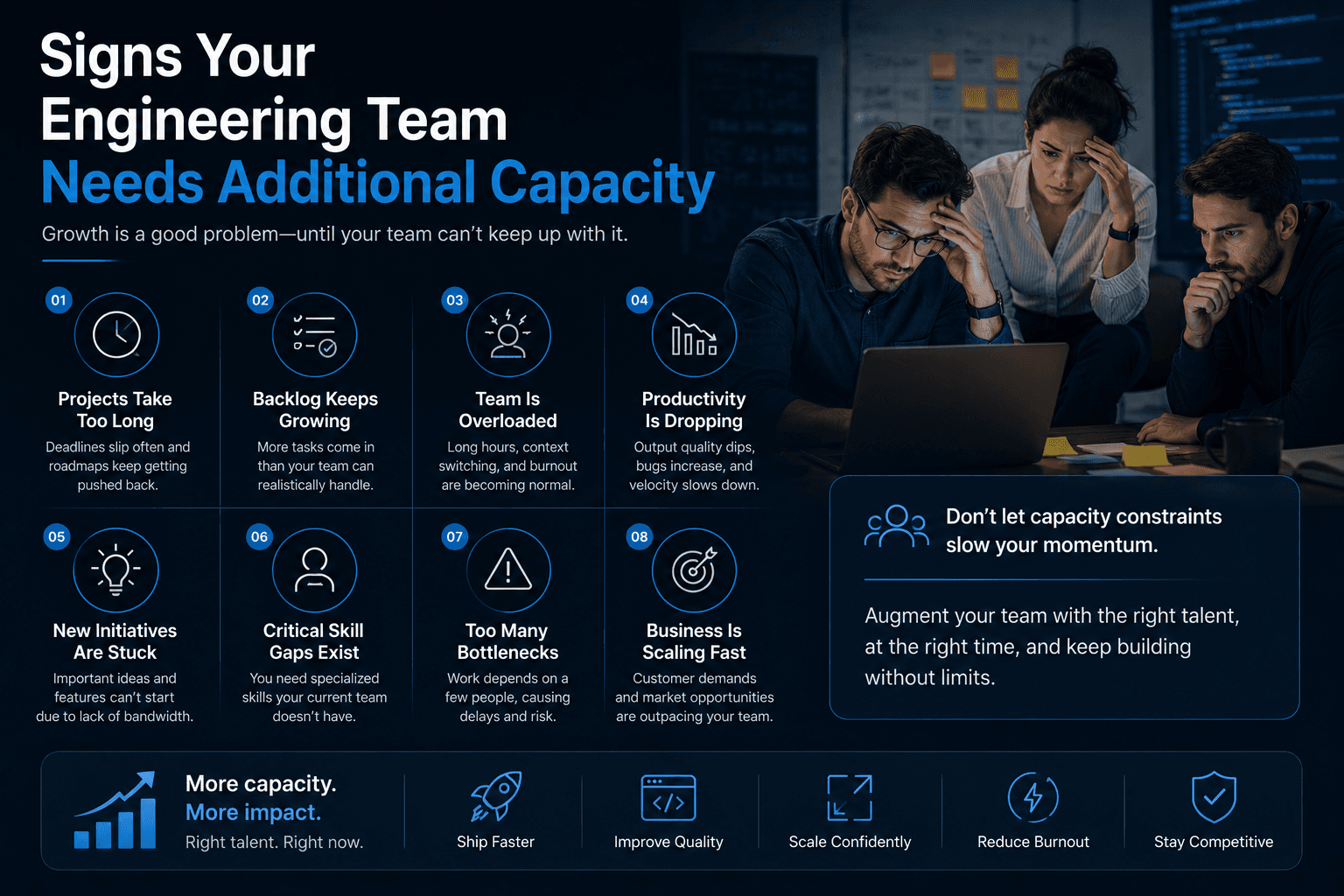
Signs Your Engineering Team Needs Additional Capacity
Engineering bottlenecks rarely announce themselves. Nobody sends an email saying the team has run out of capacity. Instead, simple features start taking longer. Deadlines get vaguer. One person becomes the answer to every question. By the time leadership notices the pattern, the team is often three to six months behind on work that matters.
The good news is the warning signs are predictable, and they show up well before the crisis does.
Simple Work Starts Taking Longer
This is usually the first sign, and the easiest to dismiss. A "quick" dashboard tweak that used to take two days now takes a week. Nobody can quite explain why. The task hasn't gotten more complex. The team just has less room to absorb it.
Watch change lead time specifically, the gap between when work starts and when it ships. Strong teams keep this under a day. When it stretches to weeks, the code itself usually isn't sitting untouched that whole time. It's waiting: for review, for QA, for a deployment window nobody has time to open.
Your Planning Horizon Has Collapsed
There was a point where the team could commit to a feature two sprints out, or even plan a quarter ahead with some confidence. If that planning horizon has shrunk to "whatever's in the current sprint, maybe," that's not a communication problem. It's a capacity problem wearing a communication problem's clothes.
Teams operating at or beyond capacity lose the ability to think ahead because there's no slack left to think with. Everything becomes reactive. Today's fire gets fought; next month doesn't get planned, because nobody has the room to plan it.
One or Two People Are the Single Point of Failure
If specific questions always route to the same one or two senior engineers, and things visibly slow down whenever they're out, that's not a knowledge-sharing problem. It's a capacity problem that looks like one.
Senior engineers running at or above full load don't have room to document systems, mentor juniors, or hand off context. They're too busy being the person who fixes everything. The fix isn't better documentation. It's enough room for those engineers to actually do the documentation and mentoring they don't currently have time for.
Deployment Frequency Is Dropping, or Failures Are Climbing With It
Two DORA metrics worth watching together: deployment frequency and change failure rate. If deployments are slowing down across multiple teams, that often points to a growing bottleneck in the delivery pipeline itself, not just the people. If failure rate and recovery time are climbing at the same time deployment frequency drops, teams are shipping less and breaking more of what they do ship, a clear sign the team is stretched past what its current process and headcount can support.
New Hires Slow the Team Down Instead of Speeding It Up
This one is counterintuitive but common. A team that's genuinely out of capacity often can't onboard new people well, because onboarding takes time and attention that nobody has left to give. The result: adding headcount briefly makes things worse before it makes them better, and leadership reads that as "hiring didn't help" instead of "the team was already too stretched to onboard properly."
If this is happening, the fix usually isn't more permanent headcount added the same way. It's capacity added in a form that needs less hand-holding to become productive, which is often where augmented specialists who ramp up fast do better than a wave of new full-time hires all at once.
A Growing Share of Time Goes to Maintenance, Not Building
Many engineering teams spend 40% to 50% of their time on maintenance and unplanned work without leadership realizing it, simply because nobody's tracking the split. If that share keeps growing and nobody's addressing it, the team's real capacity for new work is shrinking quietly, even if headcount stays the same.
What to Do Once You See Two or More of These
The pattern compounds. Waiting until every signal above is visible at once usually means the team is already in crisis mode, and development velocity can drop 40% to 60% within 90 days of the first signs appearing if nothing changes. Two overlapping signals is the point to act, not five.
The response doesn't have to mean a permanent hiring spree. If the gap is temporary, a launch, a migration, a spike in demand, additional capacity that ramps up fast and doesn't require months of onboarding often solves the immediate problem without over-committing headcount for work that will taper off later. If the gap is structural and ongoing, that's a signal worth taking to leadership directly, since it points toward a real, permanent hiring need rather than a short-term patch.
Where Amorisoft Fits
At Amorisoft, our IT staffing and resource deployment service exists for exactly this moment, when a team recognizes the signals but doesn't have months to run a full hiring cycle before the bottleneck gets worse. Professionals typically join a client's existing team within one to two weeks, working under the client's own leads and process, so the team gets relief without absorbing a slow onboarding cycle on top of an already stretched schedule.
Our Clients have used this to add capacity during exactly these windows, a deadline crunch, a maintenance backlog, a team that's lost its planning horizon, without permanently expanding headcount for a gap that turned out to be temporary.
Bottom Line
Engineering capacity problems rarely appear all at once. They show up first as small, dismissible delays, then compound into missed deadlines, burned-out seniors, and a team that can't see past the current sprint. The teams that catch two or three of these signals early and act on them stay ahead. The ones that wait for all the signs to show up at once spend the next several months in recovery mode instead.