
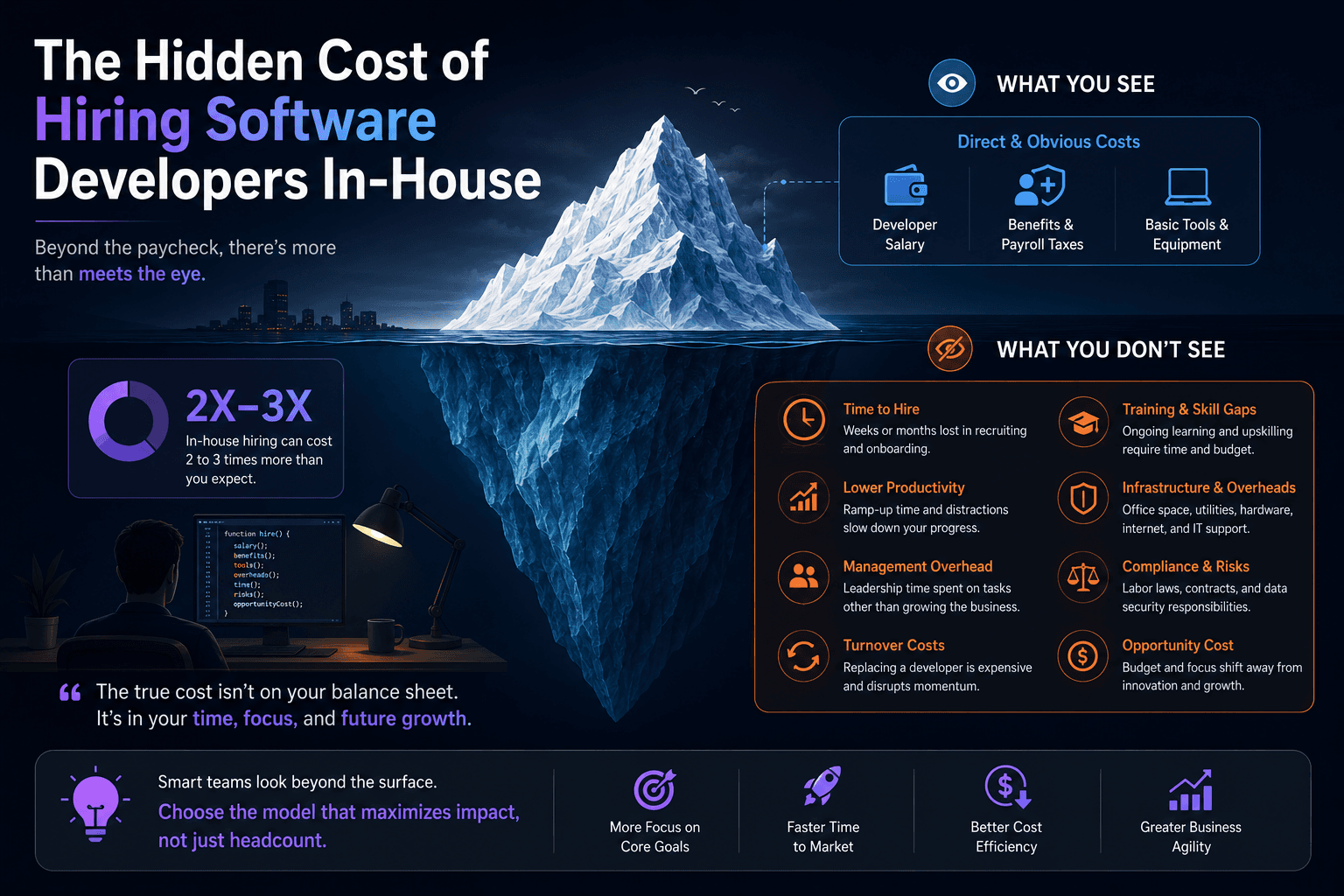
The Hidden Cost of Hiring Software Developers In-House
Ask most founders what a developer costs and they'll quote the salary. $140,000. $180,000. Whatever the offer letter says. That number is real, but it's also the smallest piece of what the hire actually costs in year one. The real total, once you add recruiting, the empty seat, onboarding, and ramp-up, usually runs 1.4x to 2.5x the base salary. A $180,000 senior hire can easily cross $248,000 in true first-year cost.
Here's where the rest of that money actually goes.
The Search Itself Costs More Than People Expect
Before anyone gets interviewed, you're already spending. A single job listing on a premium tech board runs $200 to $500, and most searches run across three to five boards. A LinkedIn Recruiter seat alone costs $9,000 to $12,000 a year. Add the hours your engineering leads spend on technical screens, and a typical in-house developer search costs $9,000 to $25,000 once you count internal time honestly, not just the line items you'd see on an invoice.
Use an external agency instead, and the fee is more visible but not smaller. Direct-hire placement fees run 15% to 25% of first-year salary. On a $150,000 hire, that's $22,500 to $37,500, due the day the person starts.
The Seat Sits Empty, and That Costs Real Money
The median time to fill a developer role sits around 41 to 52 days. For specialized or senior roles, it stretches to 82 days or more. During that window, work doesn't pause. It piles onto whoever's left, or a launch slips, or a client waits.
Industry estimates put the cost of a vacant developer seat at $500 to $1,000 a day in lost productivity and delayed revenue. For a 45-day vacancy, that's $22,500 to $45,000, often the single largest cost in the entire hiring process, and one that never shows up on a budget spreadsheet.
New Hires Don't Perform on Day One
A signed offer isn't productivity. New developers typically need three to six months to reach full output, and during that window they're often operating at 25% to 75% capacity while still learning your codebase, your tools, and how your team actually works. Onboarding time from managers and teammates alone runs 40 to 80 hours in the first month.
Put a number on that ramp-up gap and it lands around $10,000 to $25,000 in reduced productivity for a mid-level hire, on top of the salary you're already paying while they get there.
Turnover Is the Cost Nobody Budgets For
Here's the part that quietly wrecks annual budgets: 20% to 30% of new hires leave within their first year. When that happens, you don't just lose the person. You lose the search cost, the vacant-seat cost, and the ramp-up cost, then pay all three again to replace them. A failed hire on a $150,000 role can cost $75,000 to $300,000 once severance, lost productivity, and re-hiring are factored in.
Retention isn't free either. In a market where developers regularly field competing offers, keeping someone often means matching outside offers, expanding benefits, or absorbing the cost of a counteroffer. None of that shows up in the original salary figure, but all of it lands on the same budget line eventually.
Add It Up
| Cost component | Typical range |
|---|---|
| Recruiting and sourcing (in-house) | $9,000 – $25,000 |
| Agency placement fee (if used) | 15–25% of first-year salary |
| Vacant seat, 45 days | $22,500 – $45,000 |
| Onboarding and ramp-up | $10,000 – $25,000 |
| Failed hire, if it happens | $75,000 – $300,000 |
None of this includes benefits, payroll tax, or equipment, which typically add another 30% to 40% on top of base salary before any of the above even enters the picture.
What This Doesn't Mean
This isn't an argument that in-house hiring is a mistake. For roles tied to your core product, where deep institutional knowledge and long-term ownership matter more than raw speed, in-house is often still the right call, and the cost is worth paying deliberately.
What it does mean is that comparing hiring models on salary alone is comparing the wrong number. A $150,000 in-house hire and a $150,000-equivalent staff augmentation engagement are not the same total cost, because one carries a search, a vacancy, a ramp-up curve, and a turnover risk that the other structurally avoids.
Where Amorisoft Fits
At Amorisoft, our IT staffing and resource deployment service exists largely because of this gap. Clients bring us a skill gap instead of a six-week search. We handle sourcing and vetting on our end, and professionals typically join a client's team within one to two weeks instead of the 41 to 82 days a direct search usually takes. There's no vacant-seat cost stacking up while the search runs, and no agency fee due the day someone starts.
The Bottom Line
The salary offer is the number everyone plans around. It's also the smallest number on the real invoice. Recruiting, the empty seat, the ramp-up curve, and the risk of turnover routinely double the true cost of an in-house hire. Before comparing hiring models on price, it's worth asking which price you're actually comparing.