
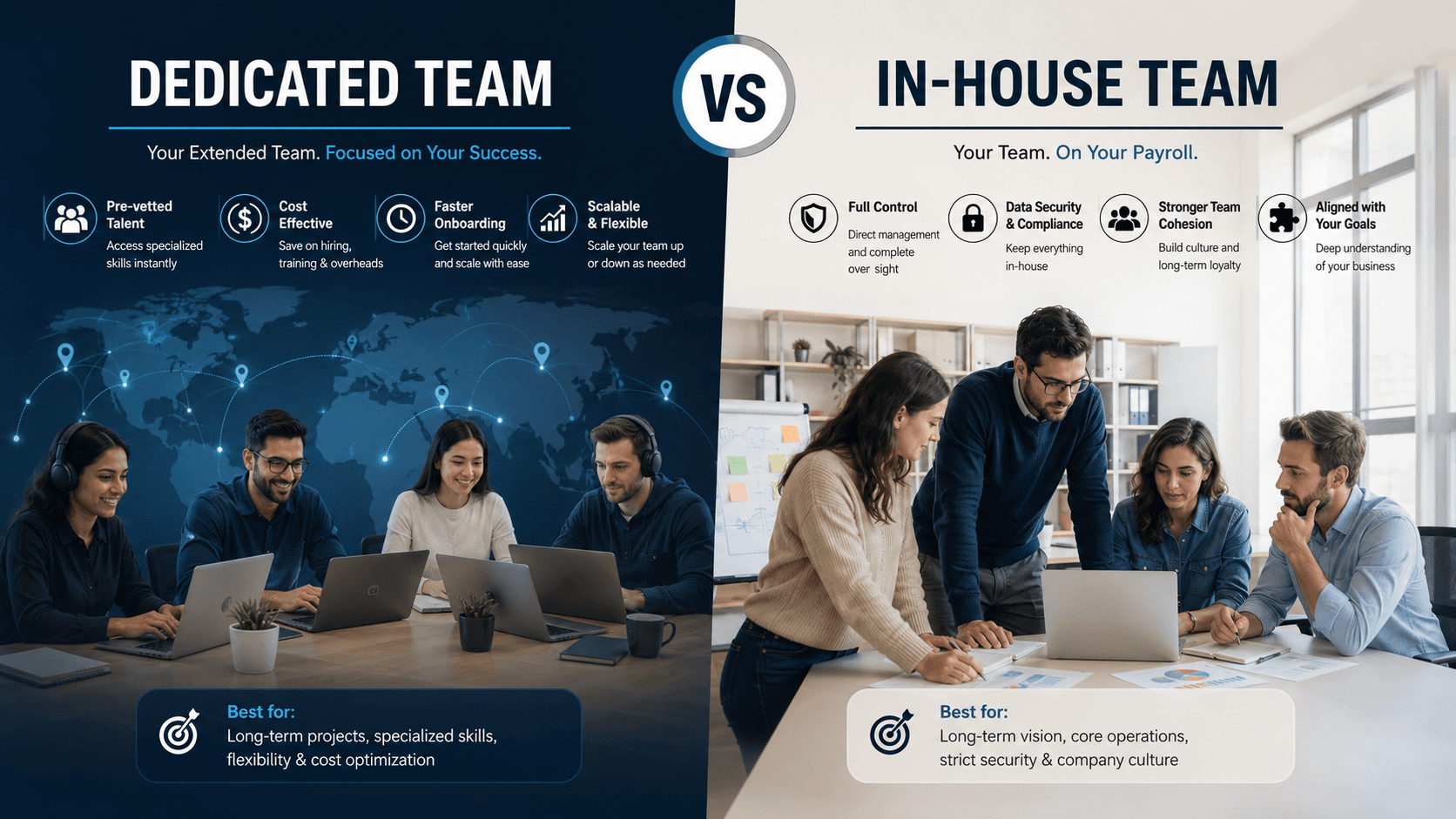
Dedicated Team vs In-House Team: Which Model Fits Your Business?
Every company scaling a product hits the same fork eventually. Build the team yourself, or bring in a dedicated team from an outside partner. Both routes get you engineers writing code. The difference is who owns the employment relationship, how fast you can move, and how much management weight sits on your side of the table.
Here's how the two models actually differ, and how to tell which one your project needs.
In-House: Full Ownership, Full Overhead
An in-house team is made up of full-time employees on your payroll, working exclusively for your company. They operate under your HR policies, get your benefits, and sit inside your culture day one. You own the entire lifecycle: sourcing, interviewing, onboarding, training, and performance reviews.
Good fit when:
- Your product is stable and the work is deeply tied to your core business
- You have the budget and HR infrastructure to support full-time hiring
- Long-term knowledge retention and cultural alignment matter more than speed
- You want architecture, standards, and hiring bars shaped entirely by you
Watch out for: hiring an in-house engineer typically takes 35 to 50 days, sometimes longer for senior or niche roles. Add onboarding and ramp-up, and the real window from open role to full productivity often stretches to a few months. Salaries, benefits, office space, and tooling stay fixed costs whether the workload is heavy or slow that quarter.
Dedicated Team: Built for Speed and Focus
A dedicated team is a group of specialists, developers, QA, DevOps, sometimes a project manager, provided by an external partner and assigned to work exclusively on your project for an extended period. They're not a rotating pool of freelancers, and they're not handed a spec and left alone the way a traditional outsourcing vendor would be. They attend your meetings, follow your delivery rhythm, and stay accountable to your roadmap. The partner owns hiring, payroll, and retention. You own product direction and priorities.
Good fit when:
- You need to move fast. Most dedicated teams can be staffed and producing within weeks.
- You need a skill that's scarce or expensive to hire locally
- Your workload fluctuates and you don't want to carry idle payroll during slow sprints
- You want to trial a working relationship before committing to permanent headcount
Watch out for: a dedicated team still needs product ownership on your side. Without a clear roadmap and someone making the calls, even a strong dedicated team drifts into a task queue with no one accountable for outcomes.
Side by Side
| Factor | In-House Team | Dedicated Team |
|---|---|---|
| Employment relationship | Your payroll, your HR | Partner's payroll and HR |
| Time to productive work | 2 to 4 months, often longer | Days to a few weeks |
| Cost structure | Fixed: salary, benefits, overhead | Monthly run rate, scales with need |
| Cultural alignment | Deep, built over time | Moderate, improves with tenure |
| Talent pool | Local market | Global |
| Scaling up or down | Slow, HR-heavy | Fast, contractual |
| Knowledge retention | Highest | Good, if turnover on the partner side is low |
| Delivery accountability | Fully yours | Shared: you own direction, partner owns execution |
Four Questions Worth Asking Before You Decide
Is this work central to your product long-term, or does it need to move fast right now? Core, long-term work leans in-house. Urgent capacity needs lean dedicated.
Can your local hiring market actually supply the skill you need, at a price you can afford? If the answer is no, a dedicated team opens a global pool without the wait.
Does your workload stay steady, or does it swing between heavy sprints and quiet stretches? Fluctuating workload is expensive to carry in-house. A dedicated team scales with it.
Do you have the HR and management infrastructure to carry full-time hires through slow periods? If not, fixed payroll during a quiet quarter becomes dead weight fast.
The Mistake Most Companies Make
Defaulting to in-house because it feels safer, without pricing in the full cost. Recruitment fees, turnover, benefits, idle capacity during slow quarters. None of that shows up in a base salary comparison, and it adds up fast.
The reverse mistake happens too. Treating a dedicated team like a black box and stepping back from direction, assuming the partner will figure out priorities alone. A dedicated team amplifies whatever product leadership already exists. It doesn't replace it.
The fix is matching the model to the actual shape of the work, not to whichever option feels more comfortable on paper.
Where Amorisoft Fits In
At Amorisoft, we build dedicated teams for clients across India, the UAE, and Canada who need engineering or delivery capacity fast, without running a full recruitment cycle themselves. Our resource deployment service assembles a team around your roadmap, and that team reports into your process while we handle hiring, payroll, and retention on our end.
For clients moving toward a fully in-house setup over time, we've also supported transition plans where a dedicated team hands off knowledge to a growing internal team. The two models aren't mutually exclusive. Most of our long-term clients run both, keeping core strategic roles in-house while using a dedicated team to absorb work that fluctuates.
Bottom Line
In-house buys control and depth that compounds over years. A dedicated team buys speed and flexibility without the weight of building an employment machine around every hire.
The right call depends less on which model sounds more serious, and more on how stable your workload actually is, and how much internal bandwidth you have to manage people.