
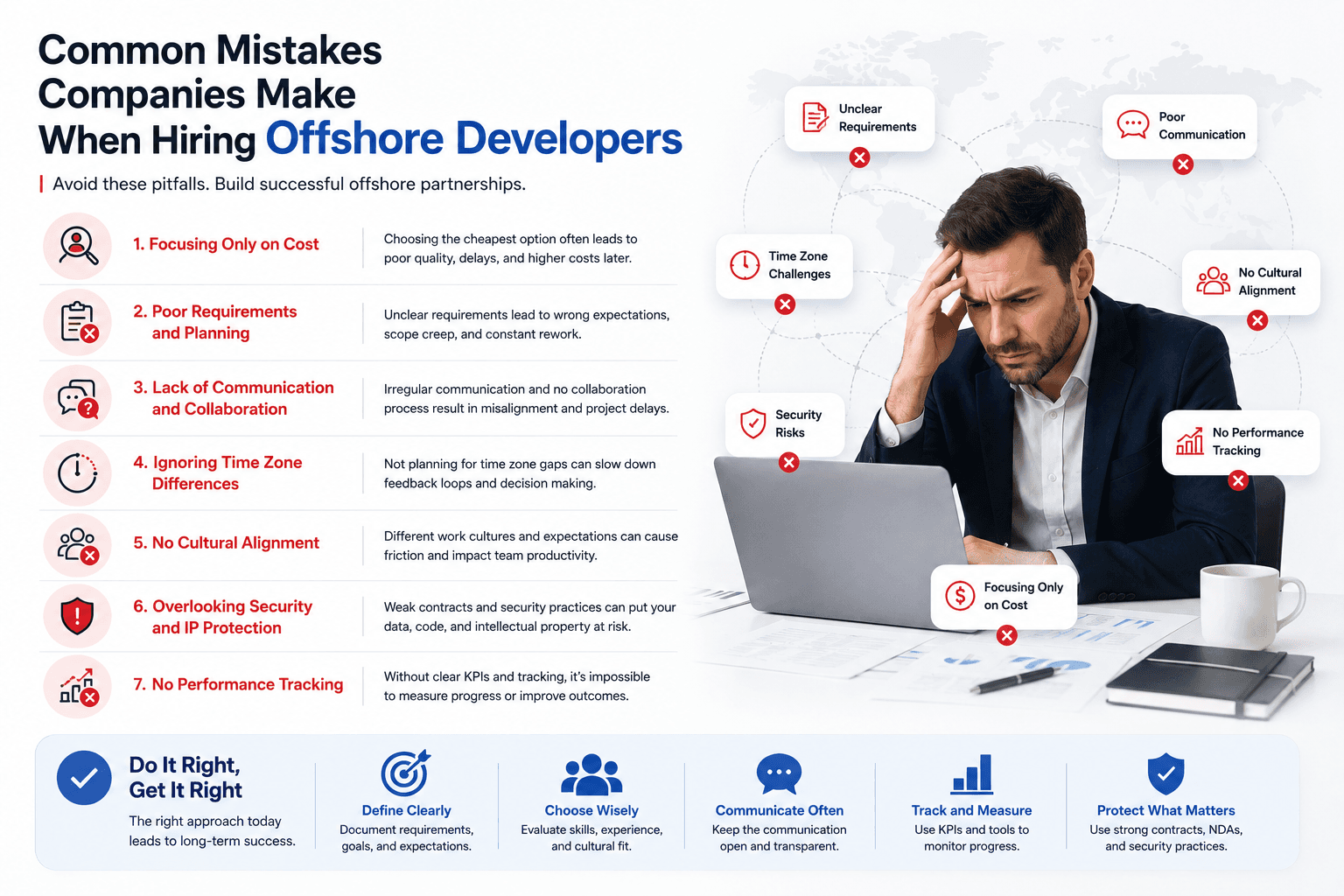
9 Mistakes Companies Make When Hiring Offshore Developers
The failure patterns in offshore hiring are remarkably consistent. Talk to enough CTOs who've had a bad offshore experience and the same handful of decisions show up again and again, almost always made before the first sprint even starts. Offshore development works. The mistakes below are what turn a genuinely good model into a cautionary story.
Mistake 1: Chasing the Lowest Rate
This is the big one, and it's rarely a single bad decision. It's a pattern: pick the cheapest vendor, don't ask why the rate is so low, find out later. Below-market rates almost always mean corners are being cut somewhere, testing, code review, senior oversight, or project management. A developer at $30 an hour whose code needs 40% rework costs more in the end than one at $50 an hour who gets it right the first time.
Fix: Evaluate total cost, not hourly rate. Factor in rework, management overhead on your side, and how much senior oversight the vendor actually provides. The cheapest number on the quote is rarely the cheapest number on the project.
Mistake 2: Skipping Technical Vetting
Relying on resumes, a vendor's assurances, or a slick sales presentation instead of actually testing the people who'll write the code. This is how companies end up with developers who look strong on paper and struggle the moment the work gets specific.
Fix: Run structured technical assessments, request code samples, and where possible, run a short paid trial before committing to a longer engagement. A 2 to 4 week trial costs a fraction of a failed year-long contract and reveals communication quality, code standards, and cultural fit fast.
Mistake 3: Starting Without Clear Requirements
Beginning a project without a defined scope is one of the costliest mistakes in offshore hiring, and one of the most common. Developers interpret vague tasks differently than you intended, requirements shift mid-sprint, and the result is scope creep, delays, and a budget that no longer matches the original plan.
Fix: Insist on a clear scope document before development starts, deliverables, timelines, and how success is measured. This matters more offshore than onshore, because there's less time overlap available to catch and correct a misunderstanding quickly.
Mistake 4: Treating Onboarding as Optional
Assuming skilled developers will simply "figure it out" once they join. Even strong, experienced engineers need context: your codebase, your tools, your team's unwritten norms, and how decisions actually get made on your team. Skip this and confusion, rework, and disengagement follow, no matter how good the hire was on paper.
Fix: Build a real onboarding process. Give access to tools and documentation on day one, assign a point of contact for the first few weeks, and check in more frequently early on than you think you need to.
Mistake 5: Weak or No Documentation
Offshore teams work with less real-time overlap than an in-house team, which means documentation carries more weight, not less. Companies that treat documentation as an afterthought end up re-explaining the same context repeatedly, and lose that context entirely when someone rotates off the project.
Fix: Require documentation as part of the engagement, not a wrap-up task at the end. Architecture decisions, API contracts, and setup instructions should exist in writing before they're needed, not reconstructed from memory after someone's gone.
Mistake 6: No Performance Monitoring
Set-and-forget management is a quiet but common failure mode. Without visibility into what's actually happening, sprint after sprint, problems compound before anyone notices them.
Fix: Track output and quality, not hours logged. Weekly demos, sprint completion rate, and code quality metrics tell you far more than a timesheet does, and they surface a struggling engagement early enough to fix it.
Mistake 7: Ignoring Security and IP Structure
External developers often need access to your codebase, cloud infrastructure, and sometimes customer data. Treating access control and IP assignment as paperwork to rush through, rather than a real safeguard, is a genuine exposure, especially for fintech, healthcare, or any regulated product.
Fix: Use role-based access, written IP assignment clauses, and NDAs before access is granted, not after. For regulated industries, confirm compliance certifications upfront rather than assuming they exist.
Mistake 8: Expecting an Offshore Team to Work Exactly Like an In-House Team
Offshore engagements have less daily overlap, and expecting the same real-time back-and-forth an in-house team gets is a setup for frustration on both sides. The reverse mistake happens too, expecting an offshore team to work completely independently without any product context, which produces work that's technically correct but misses what the business actually needed.
Fix: Structure communication for the model you actually have. Daily standups where overlap allows, structured async updates and two to three weekly syncs where it doesn't. Share business context, not just tickets, so the team understands why the work matters, not only what it is.
Mistake 9: Choosing the Wrong Engagement Model
Fixed-cost contracts fit clearly defined, short-term deliverables. Dedicated team or staff augmentation models fit ongoing, evolving product work. Picking the wrong one for the shape of your project causes friction regardless of how good the developers are, a fixed-cost model becomes expensive fast once scope shifts, and a dedicated team without a defined roadmap drifts without direction.
Fix: Match the model to the work before you match the vendor to the work. A short, well-scoped project and an evolving product roadmap need fundamentally different engagement structures.
Where Amorisoft Fits
At Amorisoft, our IT staffing and resource deployment service is built specifically to avoid the pattern above. We handle technical vetting before a professional is ever presented to a client, structure engagements around a defined scope agreed upfront, and support onboarding so a new team member is producing real work within one to two weeks instead of drifting through their first month.
Our Clients have used this to sidestep the two most common failure points: chasing the cheapest option and skipping the groundwork that makes an offshore or distributed engagement actually work.
Bottom Line
Offshore development doesn't fail because the talent pool is weak. It fails because of decisions made before the first sprint, chasing rate over value, skipping vetting, starting without clear scope, and treating documentation and onboarding as optional. Fix those nine points before signing anything, and offshore hiring performs the way it's supposed to.