
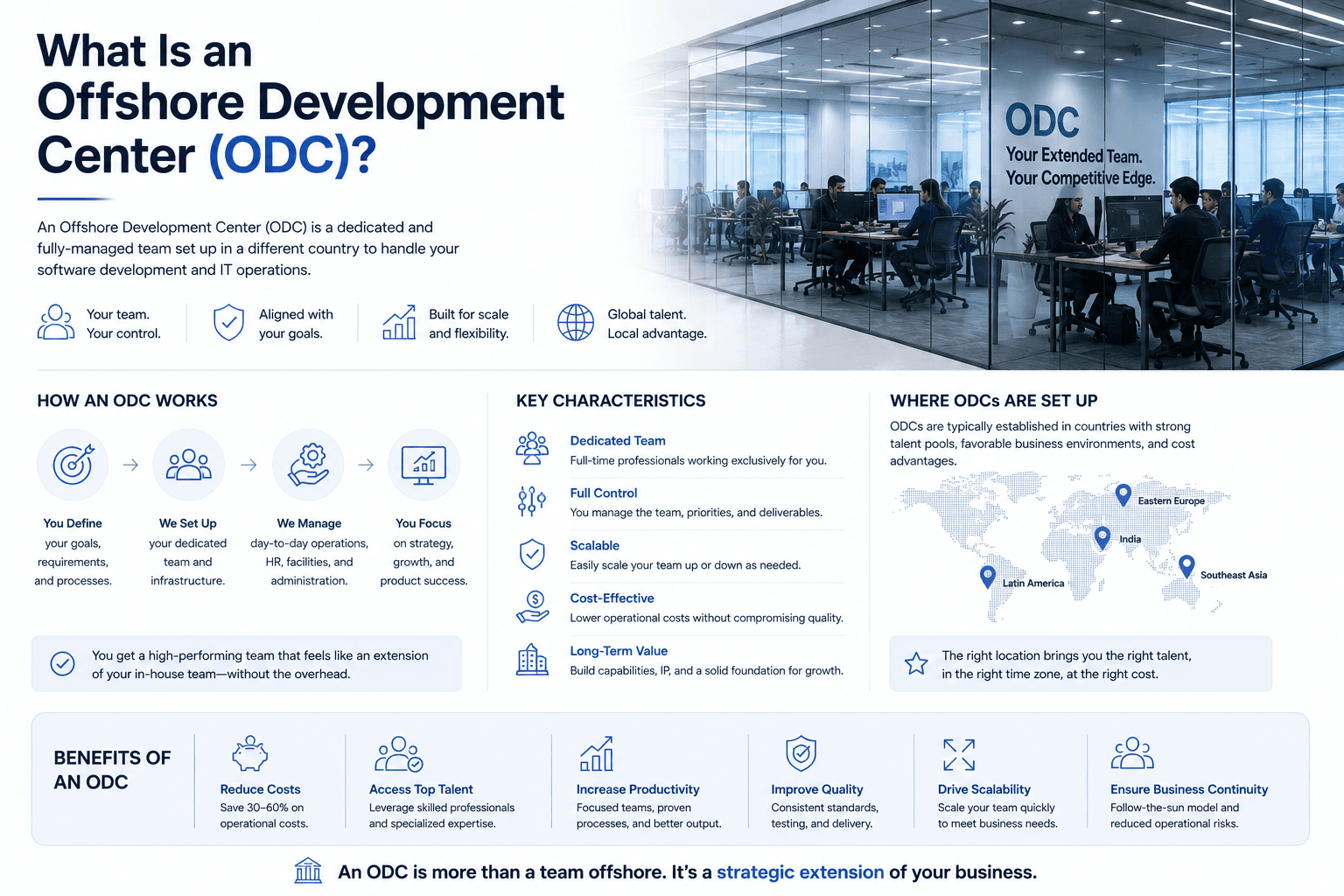
What Is an Offshore Development Center (ODC)?
An offshore development center is a dedicated, long-term engineering team in another country that works exclusively for one company, following that company's processes, tools, and standards, as an extension of its in-house team rather than a vendor delivering a project. The code, the intellectual property, and the institutional knowledge belong to the company that set it up. The team just happens to sit somewhere else.
That's the whole concept in one paragraph. The part that actually matters is what makes it different from the models it gets confused with, and when it's worth the setup effort.
What an ODC Actually Looks Like Day to Day
An ODC typically includes developers, QA engineers, DevOps specialists, and often designers and project managers, all working full-time on one company's roadmap. They follow that company's workflows and tools, report into that company's structure, and stay on the team quarter after quarter, accumulating product knowledge the way any long-tenured employee would.
This is the detail that separates an ODC from most other offshore arrangements: persistence. The same people keep working on the same product over years, not a single project with a defined end date.
ODC vs Outsourcing vs Staff Augmentation
These three get used interchangeably, and the confusion causes real decisions to go sideways. Here's the actual distinction.
Outsourcing hands a defined project to a vendor, who owns delivery of that specific scope and then moves on. You're buying an outcome, not a standing team.
Staff augmentation adds individual people to fill specific skill gaps inside your existing team, usually for a defined stretch of time tied to a particular need.
An ODC is neither. It's a persistent team built to work on your product indefinitely, with the code and IP owned by you, not the partner who helped you set it up.
| Factor | Outsourcing | Staff Augmentation | ODC |
|---|---|---|---|
| Duration | Fixed project | Defined but flexible | Long-term, ongoing |
| Who owns delivery | Vendor | You | You |
| IP ownership | Must be contracted | Yours by default | Yours by default |
| Team continuity | None after project ends | Individual-level | Whole team persists |
| Best for | Defined, scoped deliverables | Filling a specific gap fast | Core product work over years |
The Two Main Ownership Models
Captive model. The company fully owns and operates the ODC as its own subsidiary or branch office, handling recruitment, infrastructure, and security policy directly. This gives maximum control over IP, culture, and compliance, but comes with a higher upfront investment and a longer setup window, often six to twelve months once legal entity formation and office setup are accounted for.
Partner or contractor model. A local partner owns and manages the operational side, hiring, payroll, HR, office management, while the client company directs the technical work and product roadmap. This cuts setup time and operational overhead dramatically, and it's the more common entry point for companies that want the ODC model's benefits without building a foreign legal entity from scratch.
A middle path exists too: Build-Operate-Transfer, where a partner sets up the entity, infrastructure, and initial team, then transfers full ownership and operational control to the client once the center is running. This gives a company the speed of the partner model with an eventual path to full captive ownership.
When an ODC Is the Right Call
The work is core to your product, indefinitely. If this team will exist as long as the product does, not just for one release, the persistence an ODC provides starts paying for itself.
You need specialized talent that's scarce locally. AI/ML engineers, DevSecOps specialists, embedded systems engineers, roles where the local talent pool simply doesn't have enough depth to hire at the pace or price the business needs.
You want architecture and IP control that outsourcing doesn't give you. An ODC keeps technical decisions, code ownership, and product direction fully in your hands, unlike a vendor relationship where the outcome is yours but the process wasn't.
Business continuity matters. A captive or partner-run ODC that follows your own security and recovery policies can keep critical operations running even if your primary office faces a disruption.
When an ODC Is the Wrong Call
The work is a defined, one-off deliverable. A single migration, a one-time build, something with a clear finish line. Setting up a persistent team for work that ends in three months is expensive overkill. Project-based outsourcing fits better.
You need someone in place next week. ODC setup, even in the faster partner model, typically takes weeks to a few months before the team is fully staffed and productive. Staff augmentation closes an urgent gap far faster.
You don't yet have the internal capacity to direct a standing team. An ODC still needs product ownership and architectural direction from your side. Without that, even a well-built ODC drifts, since nobody's actually steering the roadmap it's meant to serve.
About Amorisoft's ODC Support
At Amorisoft, we support clients across the globe at different points on this spectrum. For clients who need capacity fast without the setup overhead of a full ODC, our IT staffing and resource deployment service functions much closer to staff augmentation, professionals join an existing team within one to two weeks, working under the client's own direction.
For clients thinking longer-term, about a standing engineering presence in India tied to their product roadmap for years rather than months, we've supported the groundwork that leads toward a partner-model ODC: sourcing, initial team structure, and operational support, with a clear path toward the client taking fuller ownership as the team matures.
The right starting point depends on the shape of the need. A defined project points toward outsourcing. An urgent, temporary gap points toward staff augmentation. A core, indefinite capability points toward an ODC.
Bottom Line
An offshore development center is not outsourcing with a different name, and it's not the same as adding a few contractors to fill a gap. It's a standing, persistent engineering team, owned and directed by you, built to work on your product for years rather than a single project. It's the right tool when the work is core and ongoing, and the wrong tool when the work is urgent, temporary, or narrowly scoped. Matching the model to which of those descriptions actually fits is the decision that matters more than any vendor comparison that follows it.