
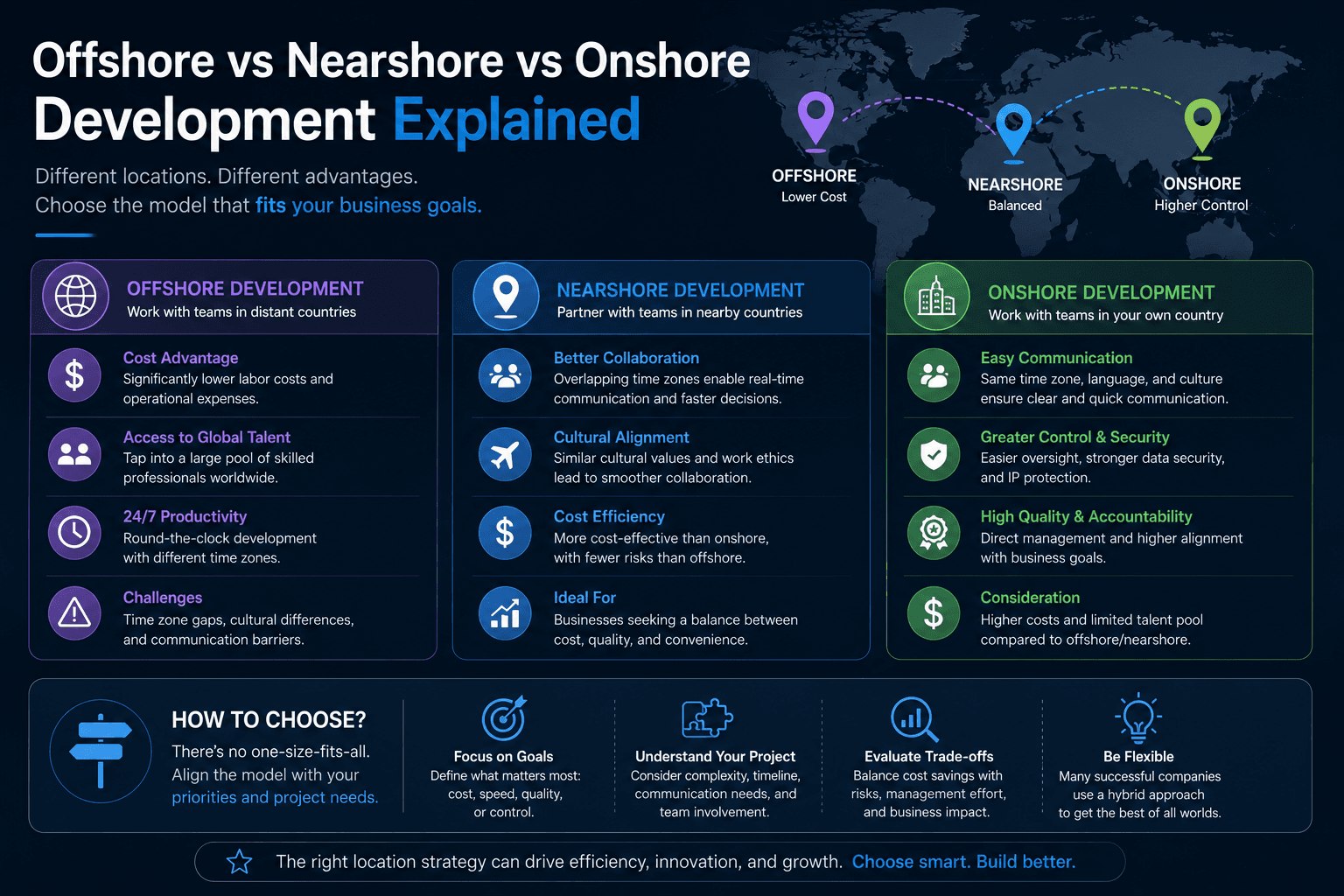
Offshore vs Nearshore vs Onshore Development Explained
The instinct is to treat this as a rate comparison. Offshore is cheapest, onshore is most expensive, nearshore sits in the middle, pick based on budget. That instinct isn't wrong, but it's incomplete enough to cause real problems six months into a project. The number that actually decides total cost isn't the hourly rate. It's how much time zone overlap you have, and how much of that overlap your specific project actually needs.
Here's what each model really means, and how to tell which one fits.
Onshore: Same Country, Same Time, Highest Rate
Onshore means your development team sits in the same country as your business. A US company hiring US developers. A UK company hiring UK developers. Rates run highest here, often $125 to $250 or more an hour in the US, but you get full real-time collaboration, shared culture, and the easiest path to in-person meetings when they're needed.
Onshore tends to make sense for highly sensitive, regulated, or IP-critical work where maximum oversight matters more than cost. It's also simply the default when a project doesn't have the scale to justify the coordination overhead of working across geography.
Nearshore: Nearby Country, Overlapping Hours
Nearshore means partnering with a team in a nearby country with a time zone gap of roughly zero to three hours. For US companies this usually means Latin America. For European companies it often means Eastern Europe. The engineers work close enough to your business hours that they can join standups live, respond during your working day, and unblock a sprint the same day something breaks.
Rates land in the middle, cheaper than onshore, a bit more than offshore per hour. But the real case for nearshore isn't the rate. It's that a full day of overlap changes how the work actually gets done. Ambiguous requirements get resolved in a conversation instead of a 24-hour email round trip. That matters enormously on products that are still evolving, where fast iteration and tight feedback loops carry more value than a marginally lower hourly rate.
Offshore: Distant Region, Minimal Overlap, Lowest Rate
Offshore means partnering with a team in a distant region, commonly India, Vietnam, the Philippines, or Eastern Europe for Western clients, where the time gap can run 8 to 12 hours. Rates here are the lowest of the three models, often 40% to 70% below onshore pricing. That headline number is real. It's also only half the picture.
A large time zone gap turns daily collaboration into something closer to a relay race: one side works, hands off, the other side picks it up hours later. Research on distributed teams has found that each additional hour of time zone gap reduces synchronous communication meaningfully, and at ten or more hours of offset, that friction adds up fast. Offshore works best for clearly scoped work with strong documentation, where the requirements are settled enough that constant real-time back-and-forth isn't actually needed.
Why the Hourly Rate Isn't the Real Number
This is the part that trips up most first-time buyers. A team that costs 30% less per hour but takes 60% longer to ship, because of miscommunication, revision cycles, or unclear handoffs, hasn't actually saved you money. Total cost of engagement depends on productivity and rework rate as much as on rate card pricing.
Turnover adds another layer that rarely shows up in the initial comparison. Offshore markets in some regions see developer attrition in the 20% to 30% range annually. Every time an engineer leaves mid-project, you're paying for onboarding a replacement and absorbing the knowledge loss that comes with it. Nearshore and well-managed offshore engagements built on long-term staff augmentation, where engineers stay assigned to one team rather than rotating across clients, tend to see meaningfully better retention, which quietly protects the cost advantage that first attracted you to the model.
A Quick Comparison
| Factor | Onshore | Nearshore | Offshore |
|---|---|---|---|
| Typical time zone gap | None | 0–3 hours | 5–12 hours |
| Hourly rate | Highest | Moderate | Lowest |
| Real-time collaboration | Full | Strong | Limited |
| Best fit | Sensitive, regulated, IP-critical work | Evolving products, tight iteration | Well-scoped, documented work |
| Typical turnover risk | Low | Low to moderate | Moderate to high, varies by region and model |
| Total cost driver | Rate | Overlap and speed | Rework and coordination overhead |
How to Actually Decide
How settled is the scope? Fixed, well-documented requirements travel well across time zones. A product still finding its shape needs the fast back-and-forth that only real-time overlap provides.
How much does IP and compliance oversight matter? Regulated industries, or work involving sensitive data, benefit from the tighter oversight that onshore or nearshore engagements make easier to maintain.
How much internal management bandwidth do you have? Offshore engagements need more structured async process, documentation discipline, and tolerance for delayed answers. If your team doesn't have that discipline built in yet, the time zone gap turns into daily friction fast.
Is this a short, defined project or an ongoing product? Defined projects with clear deliverables tolerate offshore's slower feedback loop better than a live product iterating every sprint.
A Note on India's Position
India sits in an interesting spot in this framework. For US and European clients, India is offshore, with the time zone gap that implies. But for clients within India, the Gulf, and much of Asia, Indian teams operate as onshore or near-onshore, with full business-hours overlap and no time zone friction at all. The right label depends entirely on where the client sits, not on where the development team sits.
How Amorisoft Fits
Amorisoft's IT staffing and resource deployment service functions as an onshore or near-onshore engagement, full working-hours overlap, real-time standups, no relay-race delay. For clients in North America or Europe, the same team operates offshore in the geographic sense, and we structure engagements around that gap deliberately: documented handoffs, overlapping working windows where possible, and a dedicated point of contact so ambiguity gets resolved fast even across the time difference.
Clients choosing between models often find the right question isn't offshore versus nearshore versus onshore in the abstract. It's how much real-time overlap a specific project genuinely needs, and building the engagement around that answer.
Bottom Line
Offshore, nearshore, and onshore are not a simple cost ladder where cheaper is always the tradeoff for slower. The rate on the table is only the starting number. Time zone overlap, turnover, and how much structured process the model demands from your side usually decide the real total cost. Match the model to how much real-time collaboration the work genuinely needs, not just to the number on the rate card.