
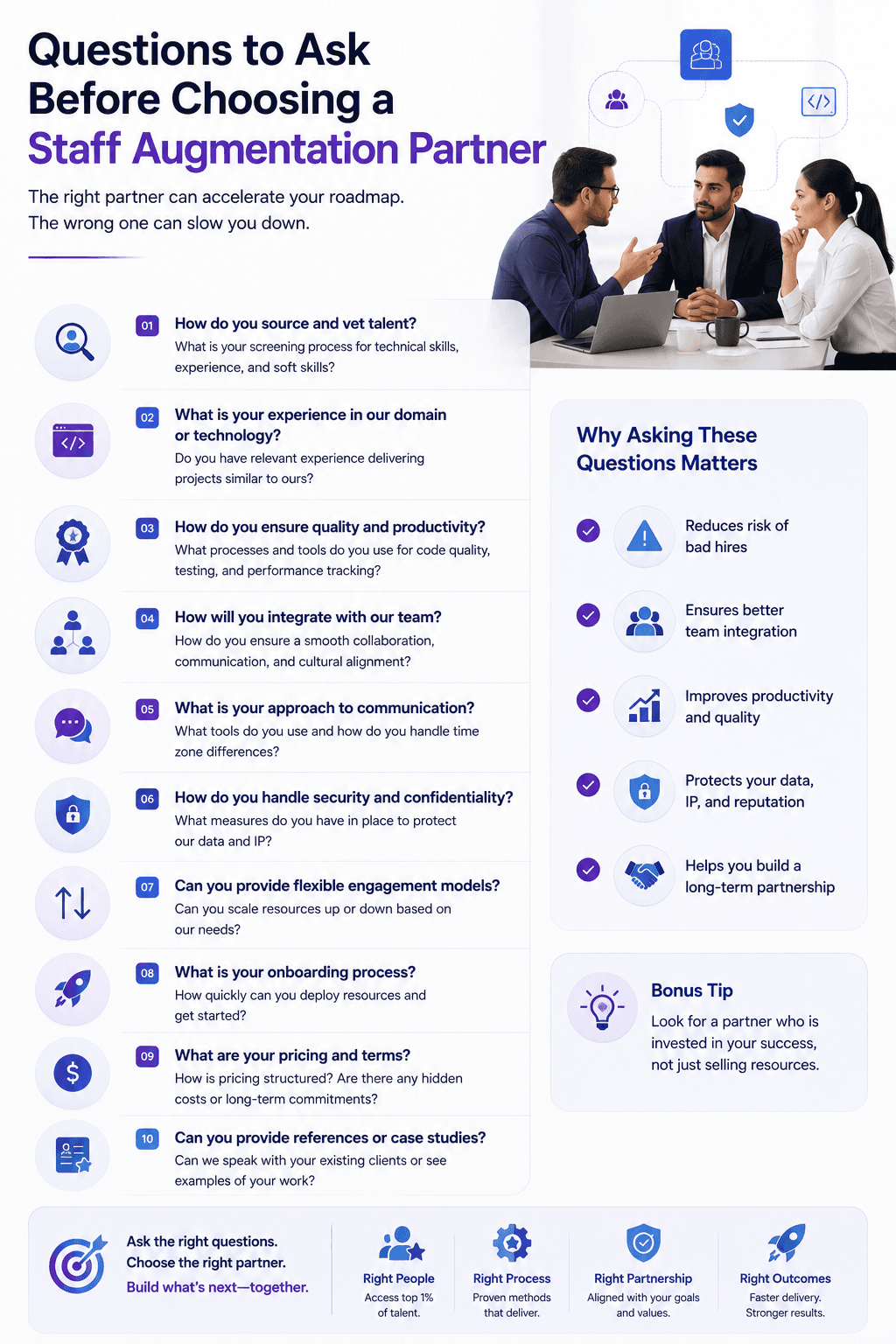
Questions to Ask Before Choosing a Staff Augmentation Partner
Most staff augmentation partnerships that go wrong don't fail because the engineers were bad. They fail because the buyer skipped structured due diligence during vendor selection, and found out the hard way what the partner's actual process looked like, three months into a contract instead of before signing one.
Every staff augmentation vendor's website says roughly the same thing: top talent, rigorous vetting, fast onboarding, flexible terms. The claims blur together fast. What separates a strategic partner from a vendor who simply fills a headcount slot is how they answer specific questions, not what their homepage promises.
Questions About Vetting
Walk me through your vetting process for a senior engineer, step by step. A vague answer here is the clearest warning sign in the entire evaluation. A real process involves multiple stages, live coding assessments, system design conversations, domain-specific technical interviews, not just a resume review and a phone call.
What's your candidate pass rate? A low pass rate, generally under 15% to 20%, is actually a good sign. It means the provider is running genuine screening rather than forwarding everyone who applies to increase their odds of a placement.
Can I see anonymized examples of assessments used for this role? Providers confident in their process will show you the bar. Providers who can't or won't are often skipping it.
Questions About Bench Depth and Speed
How many vetted engineers do you currently have available in this specific stack? Not "we can find someone." Available now, already vetted. The gap between those two answers is the gap between a partner with real bench depth and one who starts recruiting after you sign.
What's your average time to present qualified candidates? In 2026, a quality provider should surface two to three vetted candidates within about a week. Timelines stretching to several weeks or more usually mean the bench isn't as deep as the sales conversation suggested.
If I need to scale from one engineer to a small team quickly, can you actually do that? Ask for a specific example of a client they've scaled this way, not a hypothetical answer.
Questions About Retention
What's your average engineer retention rate and tenure? This is one of the two most predictive indicators of partner quality, alongside vetting depth. Retention below roughly 85% annually is a signal worth taking seriously, it often points to engineers being spread across too many clients at once, or real compensation and culture problems underneath the placement.
What happens if someone leaves within the first few months? The answer here reveals whether you're working with a partner or a transaction processor. A strong answer includes a replacement guarantee with a defined timeline, not an apologetic shrug.
What do you do after placement to keep engineers engaged? Reputable partners stay involved after kickoff, not just during the sales process. If a provider has no answer for what happens after day one, that's worth noting.
Questions About Communication and Integration
What's the realistic time zone overlap with my team? Get a specific number of overlapping hours, not a general assurance of "good communication." This matters most for teams running tight sprint cycles where a blocker needs same-day resolution.
Do your engineers have real experience with our tools and workflows? Slack, Jira, GitHub, async English communication, agile sprint cadence. Engineers without prior exposure to your specific working norms typically need a longer adjustment period than the sales conversation implies.
Is there a dedicated point of contact for escalation, separate from the engineer themselves? A single point of contact who can resolve issues quickly is one of the clearest differences between a managed partnership and a pure staffing transaction.
Questions About Compliance and IP
What IP assignment and confidentiality protections are in place before work begins? This needs to be settled in writing before any access is granted, not negotiated after a problem surfaces.
Can you accommodate our specific security onboarding requirements? Background checks, device policies, access controls. If your industry has regulatory requirements, GDPR, HIPAA, sector-specific frameworks, ask directly whether the provider has handled them before.
What data handling and access control processes protect our systems once an engineer is onboarded? External engineers who aren't direct employees introduce access questions that need clear answers upfront.
Questions About References
Can I speak directly with two or three clients at a comparable stage or complexity to mine? Not testimonial quotes pulled from a website. Actual contacts you can call. A provider who hesitates here is telling you something about their confidence in their own client relationships.
Putting It Together
None of these questions is a trick. Together they separate providers who can back up their claims with specifics from providers who redirect to a testimonials page when asked for a number. The strongest signal across all of them isn't any single answer, it's whether the provider answers with real specifics at all, or falls back to marketing language when a direct question gets asked.
How Amorisoft Answers These
At Amorisoft, our IT staffing and resource deployment service is built around exactly the standards this checklist is designed to surface. Engineers go through technical screening before ever being presented to a client, we maintain a real bench across development, cloud, and specialized technical roles, and professionals typically join a client's team within one to two weeks. A named point of contact stays involved through the engagement, not just at kickoff, and IP assignment and confidentiality terms are settled before access to any client system is granted.
Bottom Line
The wrong staff augmentation partner costs more than the invoice. It costs sprint velocity, engineering time spent managing a relationship that should run on its own, and the disruption of replacing someone mid-project. Asking these questions before signing anything is the cheapest insurance available in the entire hiring process.