
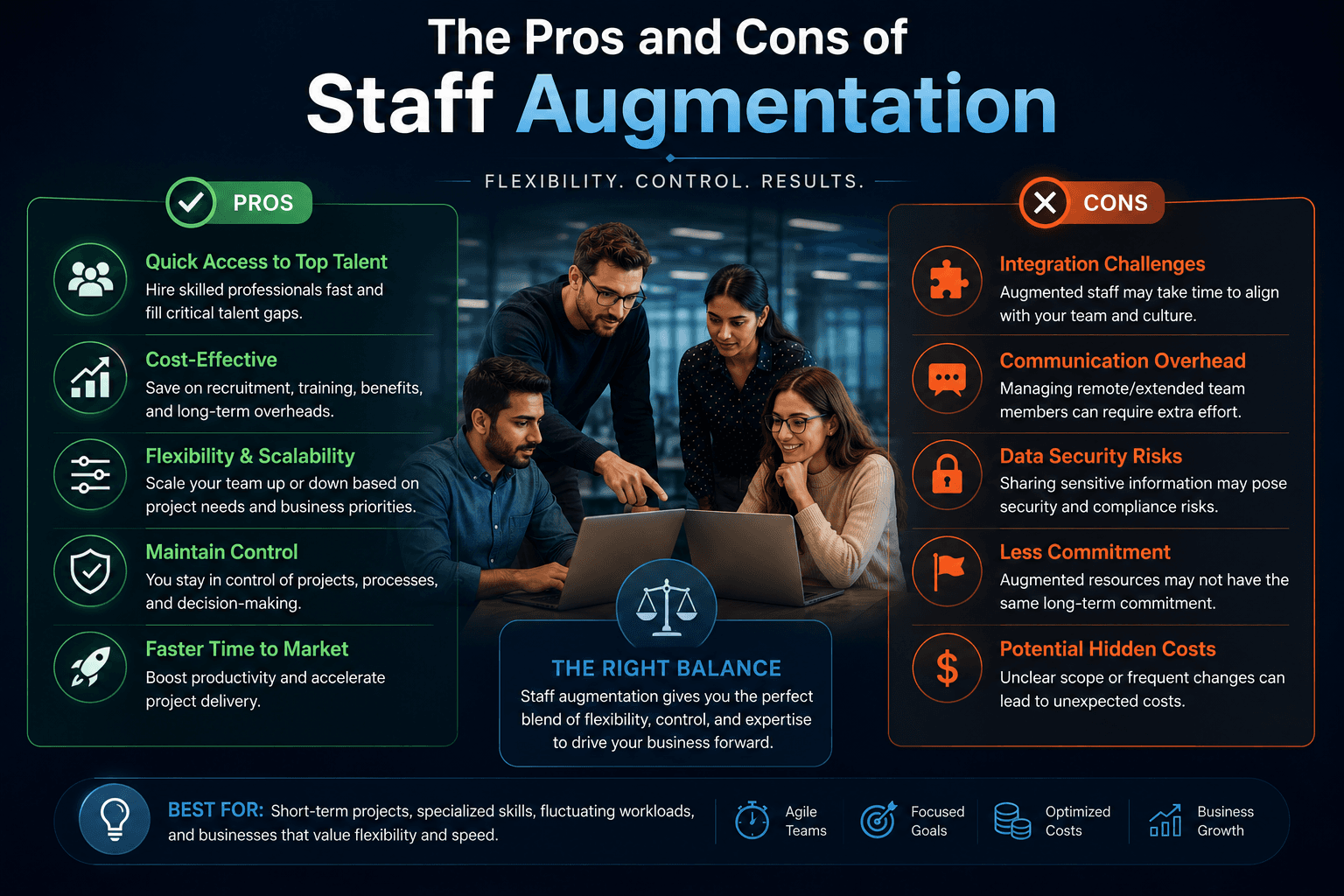
The Pros and Cons of Staff Augmentation
Staff augmentation gets pitched as a clean win. Fast access to skilled people, no long hiring cycle, no long-term commitment. That's true, but it's half the story. The model has real trade-offs, and the companies that get burned by it usually aren't victims of bad talent. They skipped the parts of the model that require effort on their own side.
Here's the honest version, benefits and costs both.
The Pros
Speed. This is the headline benefit for a reason. A senior technical hire in most markets takes 35 to 90 days once you count sourcing, interviews, and negotiation. Augmented professionals can typically start contributing within one to two weeks. If a deadline is close or a competitor just moved, that gap in timeline often decides the outcome on its own.
Access to specific, hard-to-find skills. Cloud architects, DevOps engineers, AI/ML specialists. These roles are in short supply almost everywhere, and hiring one locally can mean competing with companies that have far deeper pockets. Augmentation opens a wider pool without requiring you to relocate anyone or win a bidding war.
You keep control. Unlike outsourcing, augmented staff work inside your systems, follow your processes, and report to your people. Architecture decisions, priorities, code review standards, all of it stays yours. You're adding hands, not handing off ownership.
Cost that scales with actual need. Full-time hiring is a fixed bet. You pay someone whether the workload is heavy or quiet. Augmentation is closer to variable cost. Bring capacity in for a launch, a migration, an audit, then scale back down once the work is done, with no severance and no layoffs.
No long-term commitment. A holiday season spike, a six-week compliance push, a four-month feature sprint. Augmentation fits work with a defined edge to it. Once the engagement ends, there's no ongoing payroll obligation.
The Cons
It still requires real internal management. This is the one most companies underestimate. Augmented staff don't run themselves. Someone on your side has to define tasks clearly, review the work, and make calls when a spec is ambiguous. Skip this and even a genuinely skilled engineer sits underused, waiting for direction that never comes.
Onboarding matters more than people expect. Experienced professionals still need context: your tools, your codebase, your team's unwritten norms. Weak onboarding quietly erodes the speed advantage that was the whole reason to choose this model in the first place.
Knowledge walks out the door when the engagement ends. If documentation isn't required as an ongoing habit, not an end-of-project scramble, architectural decisions and codebase context leave with the contractor. The next person picks up where nobody wrote anything down.
Integration and quality drift are real risks. Augmented engineers plugged into a distributed team without proper oversight can implement solutions that technically work but don't match your long-term architecture. Over time, that shows up as inconsistency across the codebase that's expensive to unwind later.
Security and access need real attention. External professionals often need access to internal systems and sensitive data. Access control, NDAs, and IP assignment clauses aren't paperwork to rush through. Skipping this is a genuine exposure, not just a compliance checkbox.
It's not built for undefined work. Augmented staff execute against known requirements. If your specs are still forming, if the team is figuring out what to build as they go, augmentation adds people who spend most of their time asking what you meant instead of building.
Where the Balance Tips
The pattern across most real engagements is consistent. Staff augmentation delivers strong value when there's a specific skill gap, a defined and reasonably groomed scope of work, and someone internally ready to direct it. It quietly underperforms when any of those three pieces is missing, not because the model failed, but because the conditions it needs weren't there.
Treating augmented professionals as short-term vendors rather than team members tends to produce exactly the short-term win, long-term drift pattern that gives the model its reputation problem. Treating them as an extension of the team, with real onboarding, documentation habits, and inclusion in design decisions, tends to avoid it.
How Amorisoft Approaches This
At Amorisoft, our IT staffing and resource deployment service places professionals directly into a client's existing team, under the client's management and process. Where we can, we push clients toward the practices that make the model work: a defined scope before we place someone, a named point of contact on the client side, and documentation as part of the engagement rather than an afterthought.
Bottom Line
Staff augmentation is not a shortcut that removes management work. It's a way to add capacity fast while keeping control, provided you're willing to do the direction and documentation that make it stick. Get that part right, and the speed and flexibility are real. Skip it, and you're paying for talent that has nowhere to point itself.