
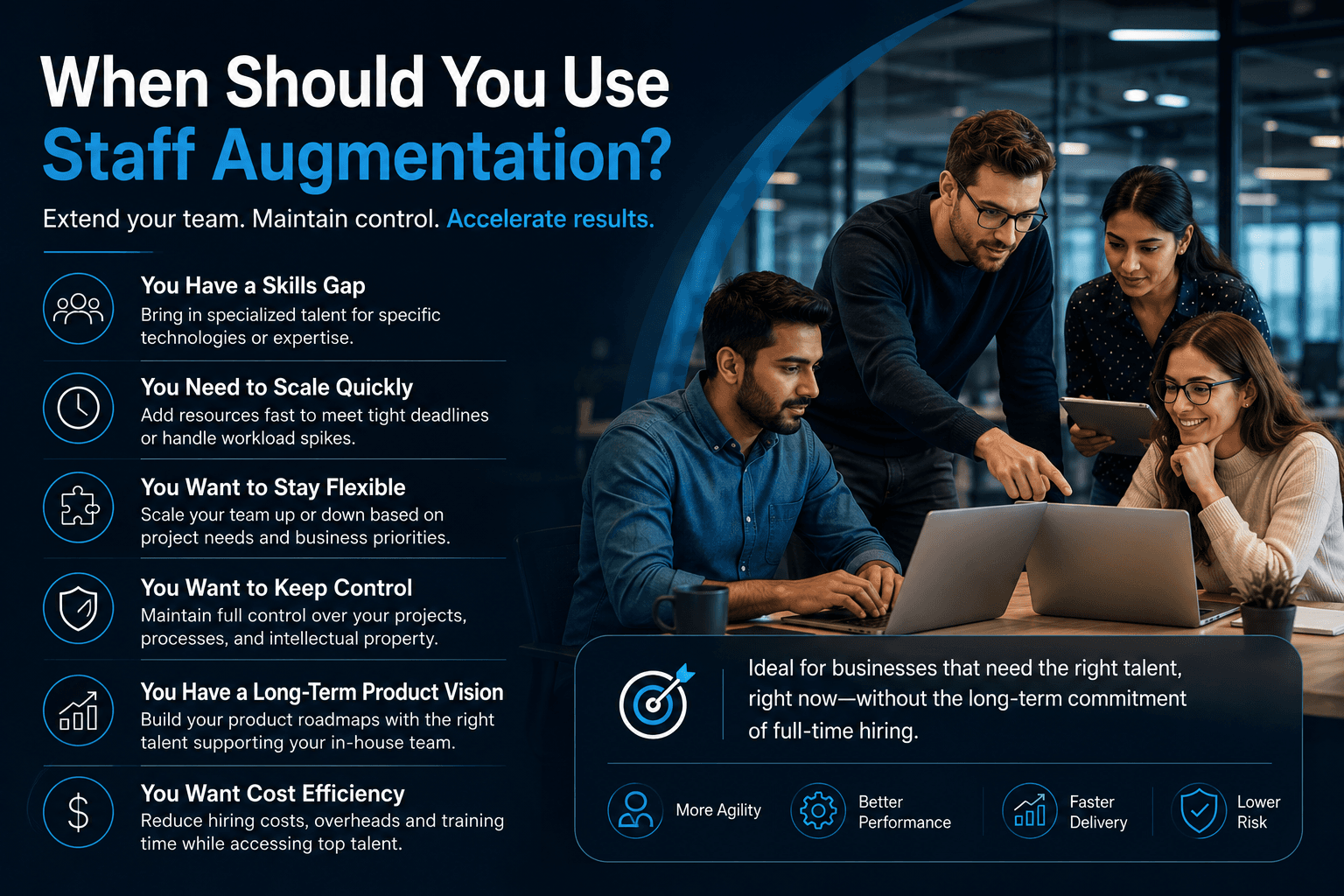
When Should You Use Staff Augmentation?
Staff augmentation isn't the right call for every gap in a team. It's the right call under specific conditions, and it fails quietly when those conditions aren't there. Not with a dramatic collapse, more with weeks of clarification loops, code that misses the point, and a client wondering why "adding people" didn't speed anything up.
Here's how to tell which situation you're actually in.
The Signals That Say Yes
There's a clear, specific skill gap. Not "we need more capacity" in the abstract, but "we need a React developer for this feature" or "we need someone who's actually built a RAG pipeline before." A vague gap produces a vague hire. A specific gap is exactly what augmentation is built to fill.
Speed matters more than building something from scratch. A senior in-house hire in most markets takes 35 to 90 days once you count sourcing, interviews, and offer negotiation. Augmented professionals can typically start contributing within one to two weeks. If a competitor just shipped something and you need to respond this quarter, not next year, that timeline gap is the whole decision.
You already have someone who can direct the work. This is the one people skip and regret skipping. Augmented staff need someone on your side who can define tasks clearly, review output, and make calls when a spec is ambiguous. Without a technical lead in place, augmentation doesn't fail because the talent is weak. It fails because nobody's steering.
Your backlog is reasonably groomed. Augmented engineers work from your priorities, not their own judgment about what matters. If there's a defined story, a clear definition of done, and enough context to make small decisions independently, they move fast. If the backlog is a pile of half-formed ideas, most of their time goes into asking what you meant.
The need is temporary or fluctuates. A feature launch, a compliance audit, a migration, a spike in demand after a funding round. Augmentation lets you add capacity for exactly that window and scale back down without layoffs or severance once the work is done.
You want to keep IP, architecture, and process in-house. Unlike outsourcing or managed services, augmented staff work inside your systems, under your standards, reporting to your people. If retaining that control matters to you more than handing off an outcome, this is the model built for it.
The Signals That Say No
Nobody internally can own direction. If there's no tech lead, no PM, no one with the bandwidth to review code and set priorities, bringing in augmented staff just adds headcount with nobody managing it. A dedicated team or a fixed-scope outsourcing engagement fits better here, since the partner absorbs that management layer.
The specs are still being figured out. Early-stage discovery, "we're not sure what we're building yet" work, benefits from a smaller, tightly integrated core team, not augmentation. Augmentation is built to execute against reasonably known requirements, not to define them.
The work is a self-contained, one-off deliverable. A portal build, a one-time migration, something with a defined start and end that doesn't need to sync daily with your internal team. That's usually a better fit for project-based outsourcing, where a vendor owns the whole outcome instead of joining your sprint cycle.
You're trying to solve a structural, ongoing capacity shortfall. If the gap isn't temporary, if you'll need this skill set indefinitely, augmentation becomes an expensive way to permanently avoid a hiring decision you were going to need to make eventually.
Three Real Scenarios
A SaaS company needs to ship a feature in four months and doesn't have enough backend developers to hit the deadline. Instead of running a three-month hiring cycle, they bring in two experienced developers through staff augmentation for the project window, managed by their existing engineering lead.
A financial services company needs cybersecurity expertise to prepare for an audit that's six weeks out. There's no time to hire, and the need ends once the audit closes. Augmentation adds the specific skill for exactly as long as it's needed.
A company with a mature in-house team hits a temporary spike, a big client onboarding, a compliance deadline, a seasonal surge. Their internal leads are strong enough to absorb and direct two or three augmented engineers without missing a step, then scale back down once the spike passes.
The Quick Self-Check
Ask these before deciding:
- Do we know exactly what skill is missing, or just that we're "behind"?
- Do we have someone internally who can manage this person's work day to day?
- Is our backlog specific enough that a new person could pick up a ticket without three rounds of clarification?
- Is this need temporary, or will we need this skill set indefinitely?
- Do we want to keep this work, and the decisions around it, fully in-house?
If most of those point toward yes, staff augmentation is likely the right call. If the honest answers point toward no direction, no groomed backlog, or a permanent need, a dedicated team or a different engagement model will serve you better.
Where Amorisoft Fits
At Amorisoft, our IT staffing and resource deployment service is built around exactly this model. We source and vet professionals across development, cloud, DevOps, and specialized technical roles, and they join a client's existing team, working under the client's leads and processes. We handle sourcing, compliance, and contracting. The client keeps direction.
Bottom Line
Staff augmentation earns its value when the gap is specific, the timeline is tight, and someone on your side is ready to direct the work. It loses value fast when none of those things are true. The model isn't the problem in those cases. The mismatch is.