
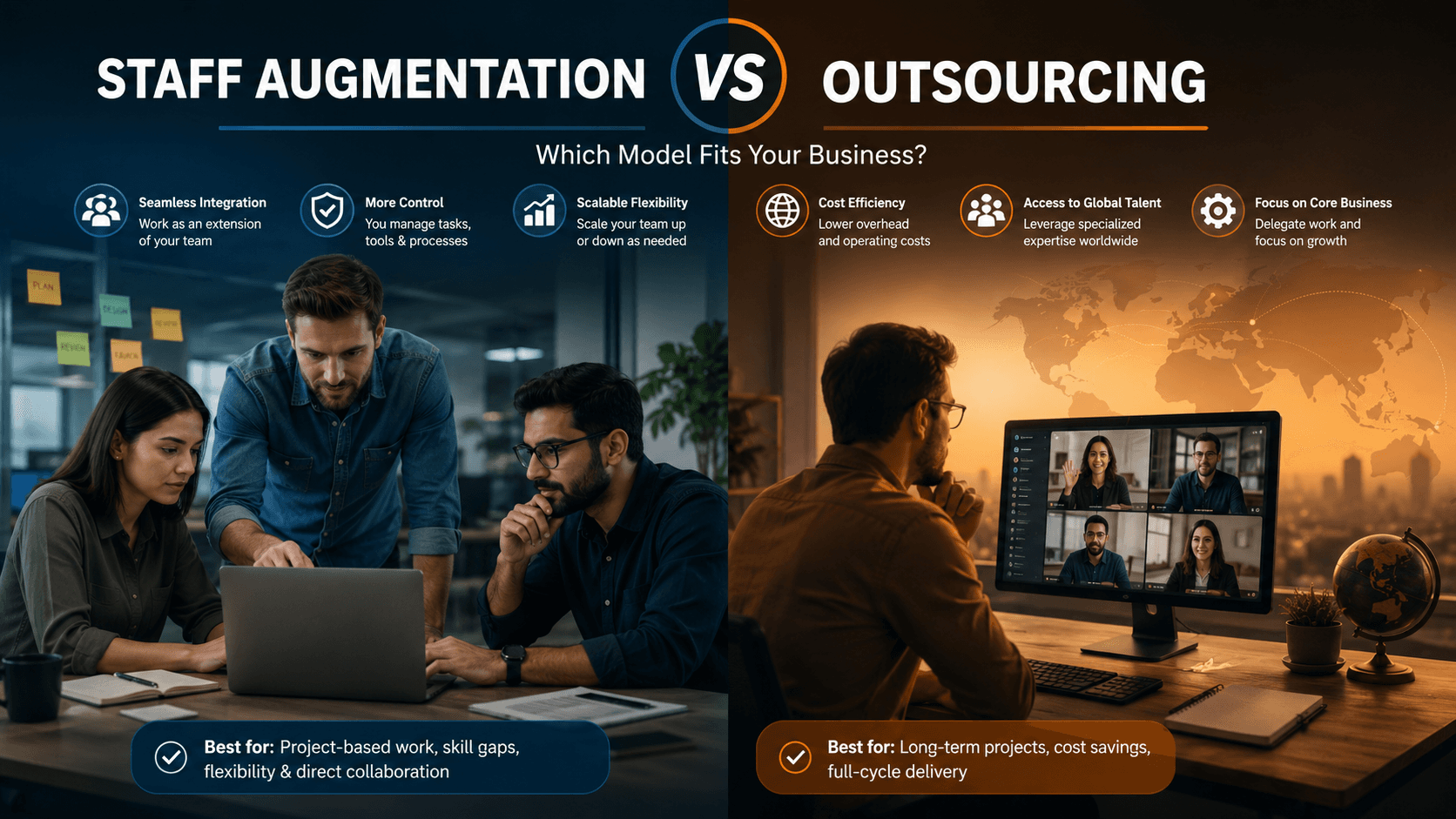
Staff Augmentation vs Outsourcing: Which Model Fits Your Business?
Every growing company hits the same wall. You need more hands on deck, but hiring full-time takes too long, costs too much, or locks you into headcount you don't need yet. So you look outside. Then you run into a second decision that matters just as much: do you bring in external talent and manage it yourself, or hand the work to a vendor and wait for the result?
That's the real question behind staff augmentation vs outsourcing. People use the terms interchangeably. They shouldn't. The two models are built differently, and picking the wrong one can cost you months of rework or your control over the roadmap.
What Staff Augmentation Actually Means
Staff augmentation means you bring in external people to work as part of your own team, under your management, using your tools and your process. They join your standups. They follow your sprint cadence. They report to your leads. Your IP, your architecture calls, your technical standards, all of it stays with you.
You're not handing off a project. You're filling a gap in your existing team with skilled people, fast, without running a full hiring cycle.
Augmentation works when:
- You already have a roadmap and a process, and just need more capacity to execute it
- You need a specific, hard-to-hire skill for a defined stretch of time
- You want to keep control over architecture, priorities, and quality
- Speed matters. Most augmentation engagements onboard someone in days to a couple weeks. A full hiring cycle takes months.
The catch: augmentation only works if someone on your side can actually direct the work. Without a technical lead who sets priorities and reviews output, even a strong augmented engineer sits idle waiting for direction.
What Outsourcing Actually Means
Outsourcing hands over ownership of a defined scope of work to another company, and they manage delivery. You're not managing a team day to day. You're managing an outcome, a contract, and a relationship. The vendor brings its own project managers and its own accountability for hitting what was agreed.
Outsourcing works when:
- You have a clearly scoped project with defined outcomes, not a roadmap that keeps shifting
- You don't have the internal bandwidth to manage execution
- You want one point of accountability for delivery
- The work is self-contained enough that it doesn't need to sync with your team's daily rhythm
The catch: outsourcing usually needs more time upfront for scoping and discovery before real work starts. And when scope changes mid-project, which it often does, that means a new negotiation, not a quick adjustment.
Control vs Convenience
Strip away the jargon and it comes down to one trade-off. Staff augmentation gives you control. You decide architecture, priorities, and how the work gets done. You're only adding capacity. Outsourcing gives you convenience. You hand off the operational load, but you also hand off a layer of daily visibility.
Neither model wins outright. They solve different problems. A lot of companies run both at once, using augmentation for evolving product work and outsourcing for a well-defined function that doesn't need daily oversight.
A Quick Comparison
| Factor | Staff Augmentation | Outsourcing |
|---|---|---|
| Who manages the work | You do | The vendor does |
| Best for | Ongoing roadmap, evolving needs | Defined, scoped projects |
| Control over process | High | Lower |
| Speed to start | Days to a couple weeks | Weeks of scoping first |
| IP ownership | Yours by default | Must be written into the contract |
| Team fit | Extension of your team | Independent delivery unit |
| Risk ownership | Mostly yours | Mostly the vendor's |
Four Questions to Decide
- Do you already have a process you want followed, or do you want someone else to own the process?
- Is the project going to keep changing shape, or is the scope fixed?
- Do you have a technical lead or PM who can manage execution day to day?
- How much does IP ownership matter here? If this work touches your core product, augmentation keeps that closer to home.
Where Companies Get It Wrong
The most common mistake is outsourcing work that's still evolving. A product still finding its shape. A roadmap that shifts every sprint. Outsourcing vendors are built for fixed scope. When the scope keeps moving, delivery slows and cost creeps up as change requests stack.
The opposite mistake happens too. Companies use augmentation for a project that's genuinely self-contained, one a vendor could have owned outright, freeing up internal management time completely.
The fix isn't picking one model forever. It's being honest about the kind of work in front of you right now, sometimes function by function instead of company-wide.
How Amorisoft Handles This
At Amorisoft we work with government agencies, PSUs, and enterprises across India, the UAE, and Canada. This exact question comes up in nearly every client conversation. Our IT staffing and resource deployment service is built for the augmentation model: professionals who join a client's existing team, follow the client's process, and answer to the client's leads. We handle sourcing, vetting, and compliance on our end.
For clients who need a defined deliverable instead, a system build, a platform migration, a portal revamp, our software development services work closer to the outsourcing model. We own the scope, the timeline, and the outcome end to end.
Most of our long-term clients use both, matched to the function rather than applied across the board. That's usually where companies land once they're past their first year of trying to scale.
The Bottom Line
Staff augmentation extends your team. Outsourcing replaces the need for one. Want speed and control? Augmentation fits better. Want to hand off a defined outcome? Outsourcing does that job.
The right call has less to do with cost and more to do with how much control you're willing to give up, and how well-defined the work actually is.