
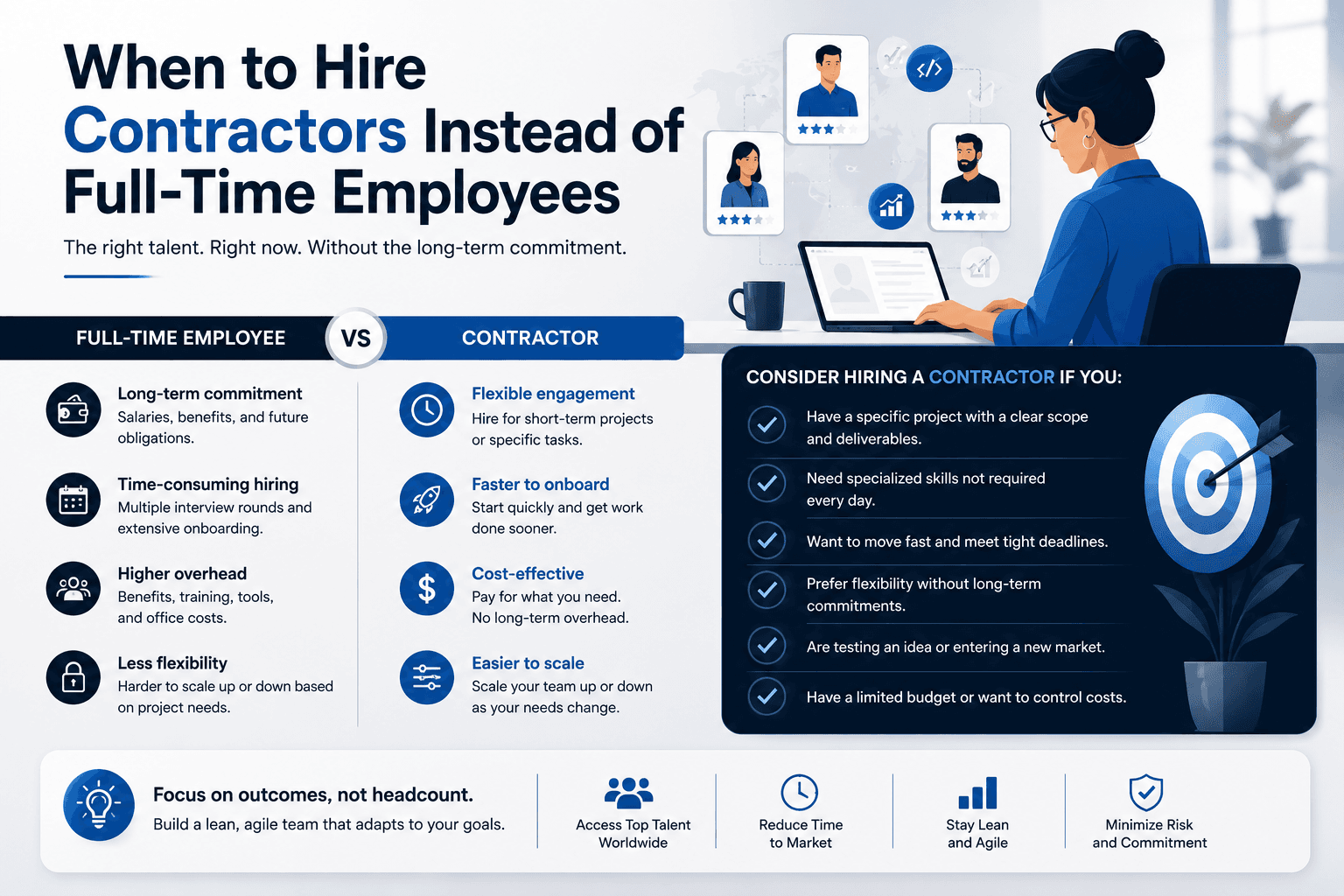
When to Hire Contractors Instead of Full-Time Employees
Every open role forces the same quiet decision before a job posting even goes up. Contractor or full-time employee. Get it right and the work moves fast without unnecessary long-term cost. Get it wrong, and you either overpay for flexibility you didn't need or lock yourself into headcount for work that was never going to last.
Here's how to actually make that call.
What a Contractor Actually Is
A contractor works for you on a defined basis, project or hourly, without going on your payroll. They handle their own taxes, don't receive benefits, and often work with other clients at the same time. You negotiate scope and rate, not a job description. The relationship typically runs three to twelve months, though it can extend on an as-needed basis.
Good fit when:
- The work has a clear start and end date
- You need a specific, niche skill you won't need indefinitely
- Speed matters more than deep cultural integration
- Budget flexibility matters more than long-term investment in the person
What a Full-Time Employee Actually Is
A full-time employee is part of your company on an ongoing basis. You provide a salary, benefits, and the tools they use, and in exchange you get someone building context and ownership over months and years. They're immersed in your culture, your roadmap, and your long-term decisions in a way a contractor structurally isn't.
Good fit when:
- The role is central to your product or business, not peripheral to it
- The work is ongoing rather than scoped to a project
- You need someone who absorbs institutional knowledge and stays accountable for it long-term
- The role requires close, daily collaboration across teams
The Real Difference Isn't Just Cost
Contractors often look cheaper on the surface. No benefits, no payroll tax, no long-term commitment. But contractors also charge higher hourly or project rates to offset that lack of security, and rehiring the same contractor repeatedly for ongoing work can, over time, cost more than a full-time hire would have.
The more useful question isn't which one is cheaper. It's whether the work is temporary or ongoing, and whether you need ownership or a defined deliverable. Full-time employees build continuity. Contractors create optionality. Both are valuable. They're just valuable for different problems.
A Quick Comparison
| Factor | Contractor | Full-Time Employee |
|---|---|---|
| Relationship duration | Fixed, project or term-based | Ongoing, indefinite |
| Cost structure | Higher rate, no benefits or payroll tax | Lower rate, but benefits and overhead add 30-40% |
| Time to onboard | Fast, minimal training needed | Slower, requires ramp-up and cultural onboarding |
| Control over work | Limited, they control how and when | High, you direct day-to-day work |
| Best for | Scoped, time-bound, specialized work | Core, ongoing roles requiring long-term ownership |
| Retention risk | Low investment, low loss if they leave | Higher investment, costlier if they leave early |
Four Questions to Ask
Is the work ongoing or does it have a natural end date? A single-use app build, a one-time migration, a defined project, that's contractor territory. A role that exists as long as the company does is a full-time hire.
Does the role need ownership, or a defined deliverable? Ownership means someone who thinks about the work long after the immediate task is done, adjusts as priorities shift, and carries context forward. A defined deliverable means "build this specific thing" with a clear finish line. The first is an employee. The second is often a contractor.
How much control do you need over how and when the work happens? Contractors set their own hours and methods within the scope you agree on. If daily oversight and real-time direction matter, that friction tends to show up fast with a contractor and rarely with an employee.
What happens if this role disappears in six months? If the honest answer is "we'd have no ongoing need for this," a contractor avoids the cost and disruption of a layoff. If the role is clearly permanent, treating it as short-term contract work usually just delays an inevitable hire.
The Mistake Most Companies Make
Using contractors as long-term stand-ins for a role that was always going to be permanent. It feels flexible early on, but the math flips. Rehiring and retraining contractors repeatedly for the same ongoing function often costs more than one solid full-time hire would have, and there's a real compliance risk if the arrangement starts to look like disguised employment under local labor law.
The reverse mistake happens too. Companies hire full-time for a role that was genuinely temporary, then face an awkward conversation, or a layoff, once the project ends and the need disappears with it.
A middle path worth knowing: contract-to-hire. Start someone as a contractor, evaluate fit and output over three to six months, then convert to full-time if both sides want it. It reduces the risk of committing to the wrong person on a guess, without giving up the option of long-term hiring.
Where Amorisoft Fits
At Amorisoft, our IT staffing and resource deployment service is built to help clients make exactly this call without guessing. When a client has a scoped, time-bound need, we place contract professionals who join the team fast and roll off cleanly once the work is done. When the need turns out to be ongoing, we've supported clients transitioning a contractor relationship into a permanent hire once that becomes clear.
Bottom Line
Contractors fit scoped, time-bound, specialized work where flexibility matters more than long-term investment. Full-time employees fit core, ongoing work that needs continuity and real ownership. The wrong call in either direction is expensive, just in different ways: one shows up as churn and repeated onboarding cost, the other as headcount you can't easily unwind.
The right call starts with one honest question: is this work going away, or is it here to stay?